

Sherrod Brown defeats Jon Husted in Ohio Senate race
Democratic senatorial candidate Sherrod Brown successfully completed his comeback and is returning to D.C. after defeating incumbent Sen. Jon Husted in Tuesday’s election. His victory in the Ohio Senate race provides Democrats with an all-important pickup in the battle for control of the upper chamber and Congress as a whole.
Big picture view:
Brown’s victory over Husted in this year’s special election means he will serve the final two years of the term to which Vice President JD Vance was elected in 2022. Vance resigned to become vice president after President Donald Trump won the presidential race in 2024 – on the same day Brown lost his seat. Now, Brown will head back to Washington to serve alongside the man who defeated him, Sen. Bernie Moreno.
RELATED: Live election results: Senate & House balance of power, governor’s races
Ohio’s other race
Local perspective:
This year’s Senate race was not the only high-profile one for Ohio voters. They also headed to the polls to decide who would replace outgoing Gov. Mike DeWine in a gubernatorial race that has garnered national headlines.
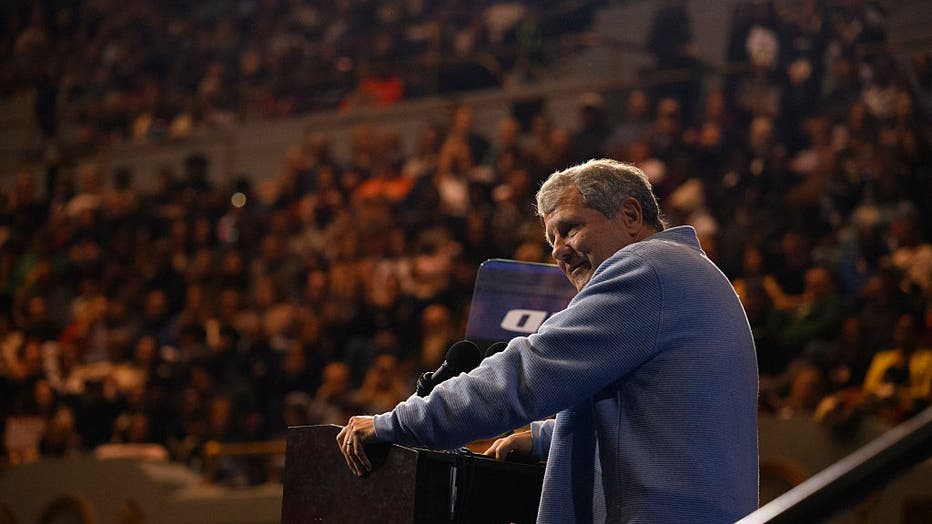
Ohio Democratic Senate candidate, former Sen. Sherrod Brown (D-OH) speaks during a campaign rally with former U.S. President Barack Obama at Cleveland Public Auditorium on October 24, 2026 in Cleveland, Ohio. (Photo by Jeff Swensen/Getty Images))
Brown’s Ohio comeback
The backstory:
Just two years ago, Brown was the sitting senator who was on the hot seat and facing voters’ wrath. In 2024, Brown was a three-term Democratic senator representing a state that has only become redder during those 18 years, and he was running in a year where Trump was swept back into office.
Twenty-four months later, Brown was the one with the wind at his back. Democrats went into Tuesday with high hopes, given sinking approval ratings for Trump and growing discontent over issues like the Iran war, tariffs, and affordability.
RELATED: New York Gov. Kathy Hochul wins reelection, AP projects

Sherrod Brown eyes Senate comeback in Ohio
FROM THE ARCHIVES: According to a new report from Axios, former Senator Sherrod Brown is eyeing a political comeback by running in 2026. The former Senator served three terms for the state of Ohio before he was defeated in last year?s election. Brown lost to Bernie Moreno as voters selected the Republican to represent Ohio in the US Senate. LiveNOW?s Andrew Craft is speaking with Karen Kasler, the Statehouse Bureau Chief with Ohio Public Media.
Pocketbook issues
Why you should care:
Economic concerns were expected to be a central issue of the race, with the cost of groceries, fuel, and other household expenses on the rise. Trade issues, particularly with the U.S. neighbor to the north, were also top of mind for many in Ohio, which sent $17.5 billion in goods to Canada last year, nearly one-third of the state’s total exports.
In suburban Cleveland, Parma City Councilor Kevin Kussmaul said he expected pocketbook matters to play a big role. During a watch party for the Republican midterm convention, Kassmaul said, "the real thing that’ll move the needle is going to be economics. Gas prices. Grocery prices. That’s really what’s going to help."
That was a note that Brown tried to hit on the campaign trail. His platform included proposals to restrict health insurance companies from denying care, lower drug prices, cap utility rate increases, and require data centers to cover the cost of their utilities.
"No one in the Senate is standing up to these corporations who raise your prices and who game the system," Brown said after securing his party’s nomination in May. "Ohioans don’t have anyone fighting for you, until November."
What's next:
Most senators wake up the morning after winning an election knowing that they will not have to run again for six years. Brown, on the other hand, will have to decide his political future much sooner than that. Because this was a special race to fill the seat held by Vice President JD Vance, who was elected to the Senate in 2022, Brown has less than two years to decide if he wants to run again and fire up a reelection campaign.
The Source: Information for this article was taken from the Ohio Secretary of State’s Office, the Associated Press, Fox News, and Parma City Councilor Kevin Kussmaul. This story was reported from Orlando.