

One monthly bill Americans can’t avoid is quietly surging thanks to emerging industry

Power Wars: Future of AI Data Centers
LiveNOW from FOX's Mike Pache spoke to Nathan Lord, president of nonprofit organization Shale Crescent USA, on the future of powering AI Data Centers. Electricity demand from data centers could account for as much as half of all new U.S. power consumption between now and 2030, according to the International Energy Agency (IEA). Natural gas is projected to meet 60% of the power demand growth driven by AI and data centers.
Americans could soon feel the artificial intelligence boom in an unavoidable place — their monthly electric bills.
Research from the Federal Reserve Bank of Dallas finds that the rapid growth of AI data centers could make electricity more expensive for households in the coming years.
And researchers estimate existing data centers that have popped up all over the country in recent years have already pushed average wholesale electricity prices 2% to 6% higher nationwide, with even larger surges in areas where these facilities are concentrated.
To estimate what could happen next, the researchers modeled how the power grid would respond to different levels of data-center growth through 2028. They first estimated how much power supply would be available, including power plants already expected to come online, and then calculated what happens to wholesale prices as different amounts of data-center demand are added to the grid.
The forecast does not assume that those higher prices would spur additional power plants to be built and connected by 2028. The researchers said that approach is justified by the short forecast window, noting that new power projects can spend more than five years waiting to connect to the grid.
A SOUTHERN STATE JUST TOOK THE TOP SPOT IN ONE OF THE WORLD’S FASTEST-GROWING INDUSTRIES
Growing electricity demand from AI data centers is raising concerns about what Americans could pay on their monthly power bills. (Raquel Natalicchio/Houston Chronicle/Getty Images)
The pressure on monthly bills could grow in conjunction with the AI boom. The preferred middle-range scenario for researchers shows the cost increases of generating electricity could be 20% to 30% higher by 2028 compared to what it would be without new data centers.
That does not mean a family's electric bill will jump 20% to 30% — that figure is much more nuanced.
Depending on its size, a single large data center can use as much electricity as a small city, according to estimates compiled by Fed researchers.
Wholesale electricity is only one part of what consumers pay for, alongside costs such as transmission and distribution.
The researchers at the Dallas Fed estimate energy costs make up roughly half of a typical retail electricity price, and wholesale increases generally take time to work their way into household rates. In short – the future of electricity bills is unclear, but is likely to steadily rise over the next two years.
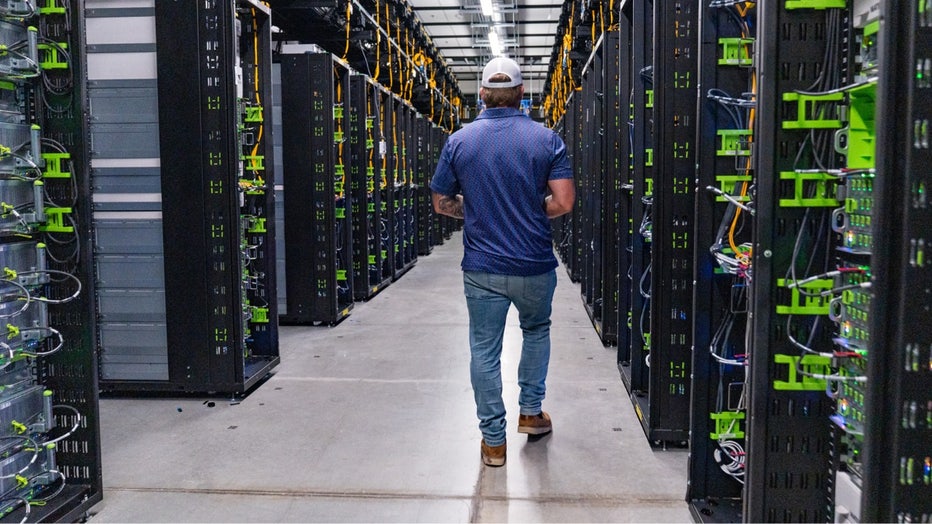
Data center development is surging across Texas, with North Texas taking the top spot in a new global ranking of the industry’s leading markets. (Mikala Compton/The Austin American-Statesman/Getty Images)
At its core, the explanation is straightforward, though the implications are more complex. Data centers need enormous amounts of electricity to run the computers behind AI.
As more data centers connect to the grid, utilities may need additional power plants, transmission lines, substations and other infrastructure to serve them.
Who ultimately pays for those upgrades depends in part on how regulators and utilities divide the costs between data centers and other customers.
The projected increases aren't solely a function of how much power data centers consume. They also depend on how quickly new power plants can come online and whether the grid has enough transmission capacity to move that electricity where it's needed. The Dallas Fed study does not break down how much of the projected price increase stems from data-center demand versus those supply constraints.
The researchers found that slower construction of new wind and solar generation would make the price effects of the same data-center demand substantially larger. They also found that easing transmission constraints could reduce price pressure in some of the areas most affected by data-center growth.
The growing strain is at the center of many political debates.
President Donald Trump has pushed to expand America's AI infrastructure while backing a voluntary pledge aimed at preventing data centers from driving up household utility bills.
TRUMP HEADS TOWARD UNLIKELY CLASH WITH CLOSE ALLY OVER FUTURE OF MULTIBILLION-DOLLAR INDUSTRY
In Texas, Gov. Greg Abbott, a Republican, has ordered regulators to halt data center projects seeking to connect to the state's main power grid until they undergo a comprehensive audit.
In Pennsylvania, Democratic Gov. Josh Shapiro has also moved to tighten oversight of large-scale data center development as the state weighs how to balance new investment with rising electricity demand.
Other governors have gone further, including Democratic New York Gov. Kathy Hochul, who imposed a one-year moratorium on new hyperscale data centers.
States continue to grapple with concerns over electricity costs, grid reliability and the rapid pace of development.