

NIPSCO bills put northwest Indiana cat shelter at risk of closing
NIPSCO bills put northwest Indiana cat shelter at risk of closing
Just as tens of thousands of people in northwest Indiana are still without power after last Tuesday's severe weather, one nonprofit is worried about how long they can stay open.
HOBART, Ind. - Just as tens of thousands of people in northwest Indiana are still without power after last Tuesday's severe weather, one nonprofit is worried about how long they can stay open.
NW Indiana cat shelter sees soaring utility bills
The backstory:
Michelle Duca has been running Feline Community Network since 2011. The Hobart nonprofit is almost entirely funded by donations and provides shelter and care for cats, including seniors, special-needs cats and animals that have nowhere else to go. But Duca says the cost of keeping the lights and heat on is becoming harder to manage.
"Every fundraiser we do is never extra money," said Duca. "It's always automatically spoken for by one of our past two bills basically to survive."
Duca tells Fox Chicago the nonprofit is constantly having to decide which bill gets paid first.
"So we're always taking from one to the next," Duca said.
We obtained the non-profit's most recent NIPSCO bill, which was more than $2,300. However, Duca told us that it's actually one of the lower bills the nonprofit has received.
"It's high enough that the rates, the fees are causing us some stress because of the billing," said Duca.
And the problem comes as donations are also falling. Duca says FCN was about 22% behind where it was in donations at the same time last year. She believes rising costs for groceries, gas and utilities are making it harder for people to give.
"If we're hurting, then we feel that they're hurting as well," Duca said. "Families are struggling, so then the trickle effect comes down to us."
‘We’re always in jeopardy of closing'
For Duca, the concern isn't simply about having to cut back. She says the shelter could eventually have to close.
"That's been a concern of ours for quite a while now," Duca said. "We can't afford to stay here, which then leaves 80-plus cats homeless."
She says the shelter is already operating with limited funding while the need for its services continues to grow.
"It's becoming more difficult every day," she said.
Duca says the situation is stressful for her employees and volunteers because they don't know whether the doors will remain open.
"It would shut our doors if those bills keep growing higher and higher," she said.
The shelter has also had to change some of the work it does because of its financial situation.
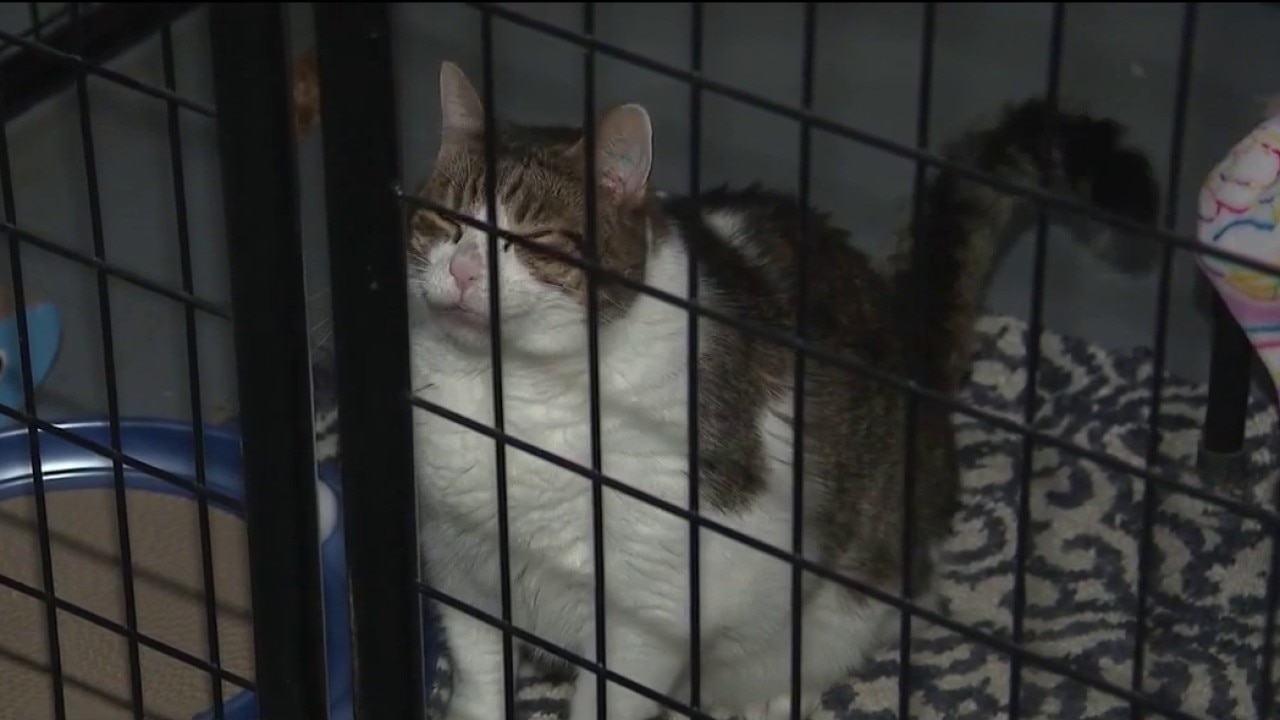
Duca says FCN once had the capacity to take in more cats from animal controls. Now, it has increasingly focused on serving as a community resource, including helping with trap-neuter-return programs, spay and neuter costs and a pet food pantry. Inside the facility are dozens of cats with nowhere else to go. Some are seniors. Others have medical or behavioral issues. Some were rescued from hoarding situations or the streets. Duca says many of them could have been euthanized if FeeLine hadn't taken them in.
"We wanted to continue that mission," she said. "But because of the donations being down, we've kind of had to resort more to being a resource facility."
The shelter also cares for cats that may be difficult to adopt. One of them is Rowan, who Duca says was shot in the head and abandoned at a veterinary clinic. The injury damaged his eyes. Another cat, Peanut, was attacked by a raccoon and lost his ear. Others have spent years at FCN and are considered permanent residents. Duca says the cats are part of what makes the possibility of closing so difficult.
"They're our family until that happens," she said.
The interview came during the summer, in the middle of a power outage. Duca is already thinking about what higher heating bills could mean when temperatures drop. She says she plans to do whatever she can to keep costs down.
"I'm gonna be putting up a whole lot of plastic on the windows and keeping the heat as low as I can and giving the cats some extra blankets," Duca said.
Her goal is simple: make sure there is enough money to keep the shelter open.
"And hopefully we make it through the winter this year," she said.
Duca also points to her own household as an example of how difficult utility bills have become.
She says her personal NIPSCO bill was about $750 one month — more than her husband's truck payment and, when combined with an agreement payment, more than their mortgage.
"It was insane for two people," she said.
Duca says lawmakers need to take a closer look at utility costs and how increases are affecting Hoosiers.
"They need to take a real hard look and start working to help the residents and the Hoosiers," she said.
Duca was also critical of the Indiana Utility Regulatory Commission's decision involving NIPSCO's rate request.
Even though the commission did not approve the entire increase NIPSCO requested, Duca says customers are still facing higher costs.
"They still gave them an increase," she said. "If it wasn't the full or not, they still gave them an increase, and that's really going to trickle down to all of us."
What's next:
For now, Duca says FeeLine is relying on the community to keep the shelter running. She says people don't necessarily have to donate money to help.
Volunteering, donating supplies, shopping at the shelter's cat-themed gift shop or simply helping a neighbor can make a difference.
"We'd love to be able to help continue our mission here," Duca said. "And we can do that with the community support."
But as the bills continue to arrive, Duca says the stakes remain high.
"We need all the help we can get to keep these guys have a roof over their head," she said.
And perhaps her simplest message is the one aimed directly at the cats' biggest expense:
"NIPSCO needs to stop taking all my money, or the cat's money," Duca said. "Stop taking the cat's money."
The Source: The information in this article was reported by FOX Chicago's Bret Buganski.