

On Emmett Till’s 85th birthday, remembering a boy's life and the echoes of history
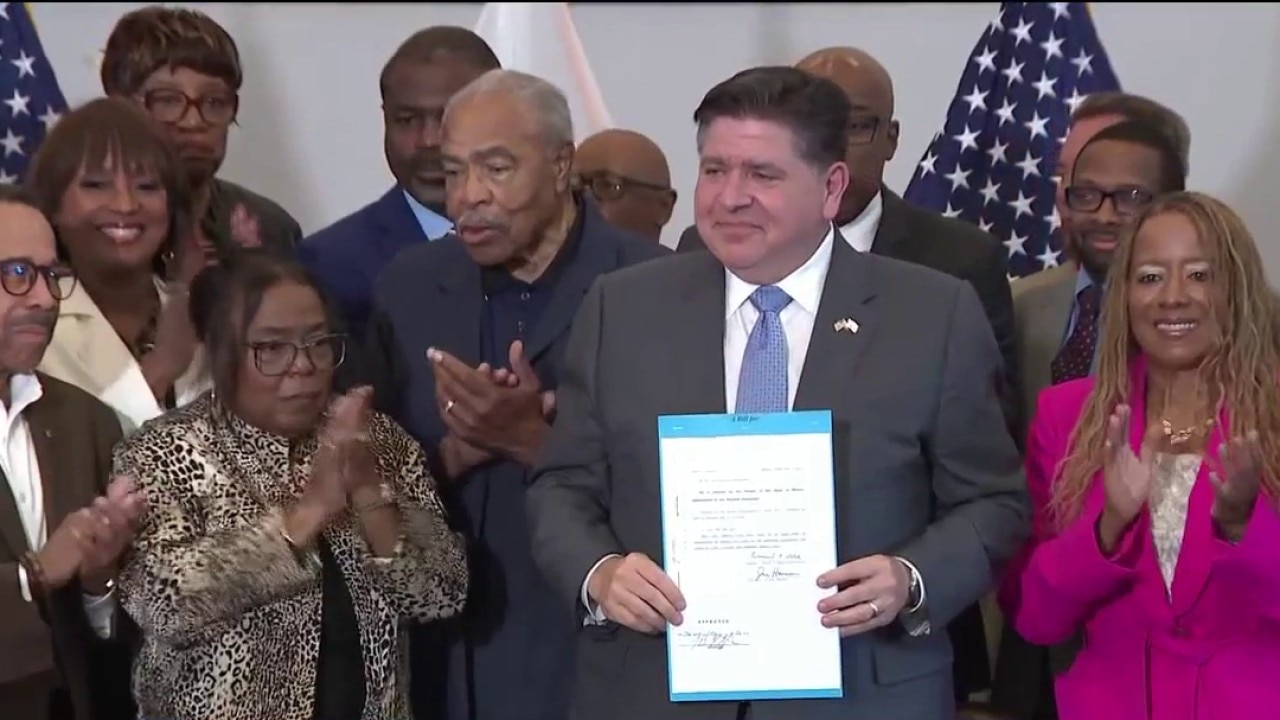
Pritzker declares July 25 Emmett Till Day in Illinois: 'To ensure the truth is told'
Gov Pritzker established July 25 as Emmett Till Day in Illinois to honor Till's birthday, legacy, and lasting impact.
CHICAGO - Emmett Louis Till would have turned 85 years old today.
He never saw his 15th birthday, got to start his own career, or have his own family. One wonders how he would have spent today: reflecting on a long, fulfilling life, reminiscing with old friends, perhaps even surrounded by his children and grandchildren.
Instead, he is forever captured in the nation’s collective memory as a 14-year-old boy who became a victim of its racist violence. Many point to his lynching as one of the key events that sparked the Civil Rights Movement.
In August 1955, a little over a month after Till’s 14th birthday, he traveled to the Mississippi Delta to visit family. While at a drugstore, he whistled at Carolyn Bryant, a white woman. It was a juvenile indiscretion that, in the Jim Crow South, was a death sentence simply because he was Black.
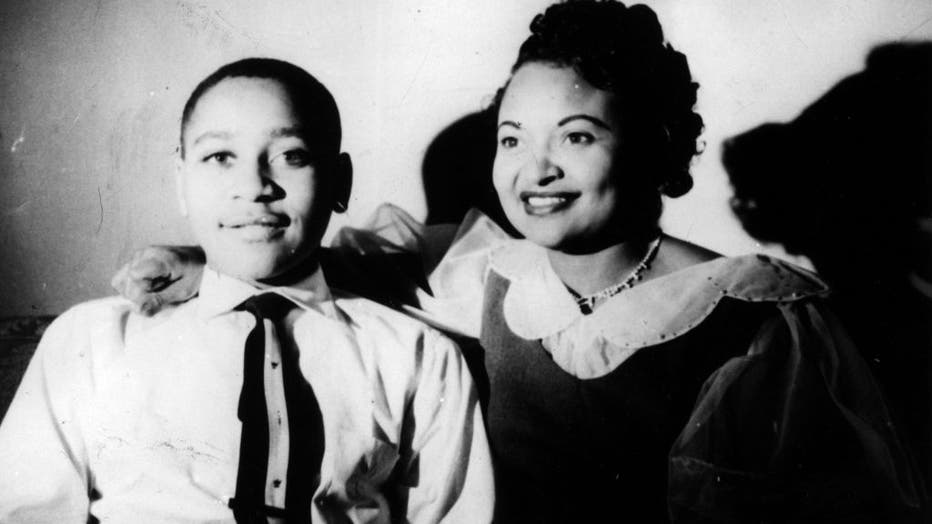
Emmett Louis Till with his mother, Mamie Till-Mobley, at home in Chicago. (Chicago Tribune file photo/Tribune News Service via Getty Images) ( )
Days later, on August 28, Bryant’s husband, Roy, and his half-brother J.W. Milam went to the home of Till’s great-uncle, where he was staying, kidnapped the boy at gunpoint, and took him back to a barn where they tortured and murdered him.
Till’s body was found days later in the Tallahatchie River, horribly mutilated. After his remains were returned to Chicago, his mother, Mamie Till-Mobley, decided to show the world what America’s racism had wrought.
"Let the people see what they did to my boy," she said, in the midst of her grief.
Thousands attended Till’s funeral at Roberts Temple Church of God in Christ on Chicago’s South Side. The horrific images of his remains were shown in publications widely read by Black Americans.
A few months later, on Dec. 1, 1955, Rosa Parks boarded a bus in Montgomery, Alabama, and refused to give up her seat for a white man. It was an act of protest against the American caste system that would also reverberate through history.
Later, when asked why she refused to go to the back of the bus, Parks said she was thinking of Emmett Till.
"I couldn’t go back," she said.
What followed were years of boycotts, civil disobedience, rebellions, and images of ordinary people standing up to an oppressive and fundamentally unequal system. Black Americans risked their bodies and, in some cases, paid with their lives for the basic right of equality under the law.
Till’s lynching and the bravery of his mother and many others in the face of a centuries-old system marked yet another important chapter in America’s struggle for a more perfect union.
"I think one of the reasons that Till’s story has come back is because [of] its ability to shock us. It's just so profound," said Elliott J. Gorn, the author of "Let the People See: The Story of Emmett Till," and a professor of American history at Loyola University Chicago. "I mean, you look at his picture, and he's a 14-year-old kid."
While Till has become an icon of American history, he was also just a boy.
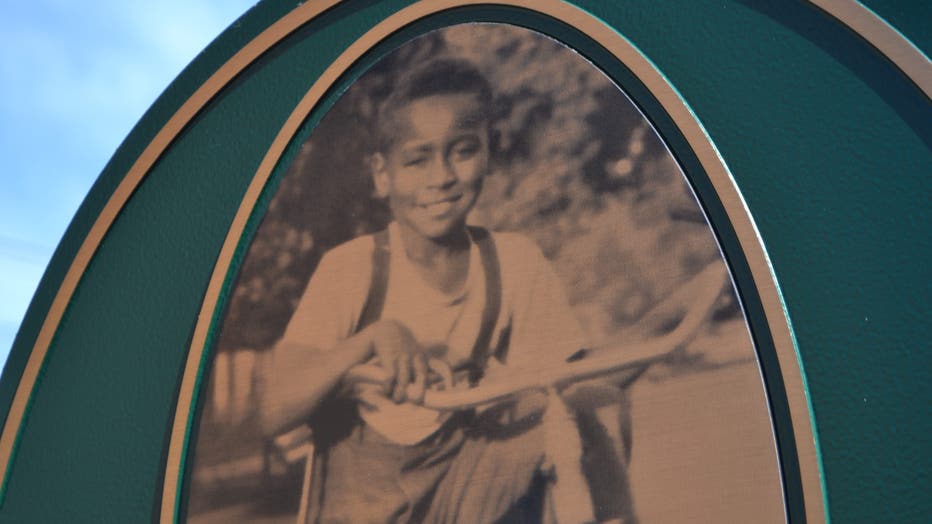
A photo depicts Emmett Till around age 9, taken around 1950 in his hometown of Summit, Illinois. (Fox Chicago)
‘Forever fourteen’
Mamie Till-Mobley detailed her and Emmett’s life in her 2003 book, "Death of Innocence: The Story of the Hate Crime That Changed America," which she wrote with Christopher Benson, a journalist and attorney who teaches at Northwestern University.
In the introduction to her book, Till-Mobley wrote that she wanted "people to know my Emmett, the way they might have known him had they met him so many years ago – as the driven, industrious, clever boy that he was at age fourteen. Forever fourteen."
She called Emmett her "miracle baby," after a difficult breech birth. Doctors at Cook County Hospital feared he’d be disabled. She described how happy she was the first time she held her boy, who weighed six and three-quarters of a pound.
"Oh, honey. Mama loves you," she told her son.
Till-Mobley described Emmett as a happy child who loved to play baseball, was at times forgetful, and, despite a pronounced stutter, was a "talker."
His loved ones called him Bobo, a nickname a family friend gave to him while he was still in the womb.
While he was "two hundred percent boy," Emmett also had a tender side, his mother wrote. He would frequently look after his younger cousin Alma and he picked Mother's Day cards that expressed "just the right sentiment."
He also loved animals. While on that trip to Mississippi in 1955, Till was riding in a car with his cousin when they ran over a dog. He begged to stop the car so he could check on the animal. When his cousin refused, Emmett cried.
Till spent his early years growing up in what is now Summit, a suburb just southwest of Chicago. The Tills’ home at 7526 64th Street is now a lot with a memorial. A photograph shows a younger Emmett on a bicycle, smiling, dressed in overalls and a white T-shirt.
Till’s cousin and best friend, Rev. Wheeler Parker Jr., was also in that photo as a boy. Parker moved in next door after his family came from Mississippi. He was a couple of years Emmett’s senior and was much like an older brother. Till-Mobley wrote that Parker was like Emmett’s "other half."
Parker also only ever called his cousin "Bobo." To this day, he says it’s hard to refer to him as "Emmett."
"He’s just a fun-loving person," Parker said in an interview.
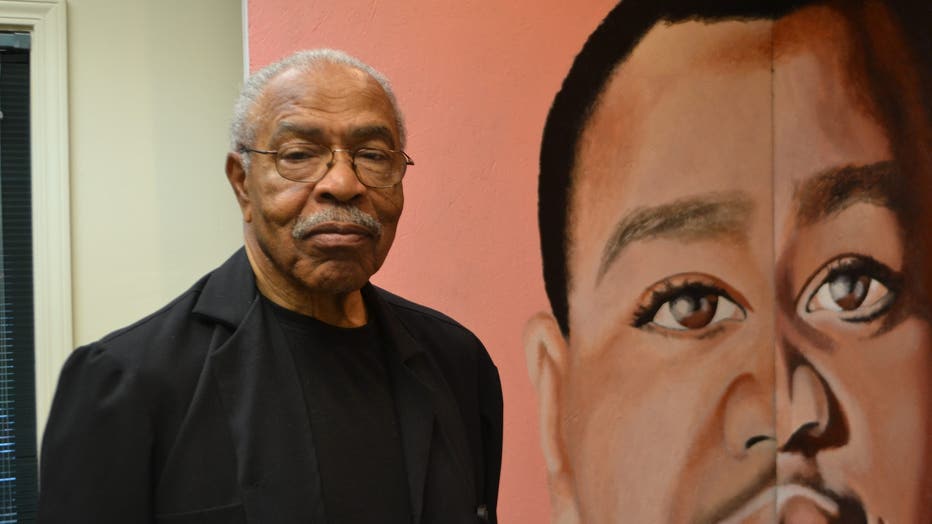
Rev. Wheeler Parker Jr. poses in front of a photo of his cousin, Emmett Till, on July 3, 2026. Parker was one of the last to see Till alive in August 1955 before the boy's lynching in the Mississippi Delta.
Sitting in an office at the Emmett Till Memorial Center in Summit, Parker pointed to the photo of him and his cousin on their bikes.
"Do you see? That’s the picture over there," he said and referred to Till’s smile. "That’s him."
Parker, now 87, still lives in Summit, where he pastors at Argo Temple Church of God in Christ, just down the street from where he and Emmett grew up. Parker was also with his cousin on that trip to Mississippi and was one of the last people to see him alive.
Parker said he could only imagine what his cousin would have done had he lived. He imagines that Emmett would still have had that ability to draw attention and laugh through the vicissitudes of life.
While such ideas are merely "what ifs?" the magnitude of his cousin’s legacy is very real, as is the pain of his loss.
"He does more in death now than if he had lived," Parker said. "We’d rather have him here, but the things that come about, the change that comes about because of his death, does more than if he had lived, and … when you say that, you got to have mixed emotions."
Parker has worked for decades to ensure that his cousin’s story is never forgotten. He's spoken of the survivor's guilt he felt for years after his cousin's murder.
Still, it took 30 years for any journalist to interview Parker about the case.
It wasn’t until almost 50 years after Till’s murder that the FBI undertook a serious effort to bring the perpetrators to justice. Federal and Mississippi state authorities reviewed the case and pursued leads, but ultimately no charges were brought.
Then, in 2017, investigators looked into whether they could prosecute Carolyn Bryant, who by then had remarried and taken the last name Donham, after an author claimed she had recanted the story she originally gave under oath for the 1955 murder trial.
Investigators concluded no charges could be brought against Donham or anyone else related to the killing.
The case was officially closed in 2021.
Carolyn Bryant Donham died in 2023.
No one has ever been charged or convicted.
Despite the killers never being brought to justice, shortly before her death in 2003, Mamie Till-Mobley spoke about the pity she had for them and how her faith convinced her to reject hatred.
"I can truthfully say that for 47 years, I have not wasted any time hating Milam and Bryant," she said. "They became inconsequential so far as I was concerned. It was as if they didn't even exist."
History rhymes
The signs of remembrance are everywhere, especially in Summit. The Emmett Till Memorial Center sits on 76th Avenue, which has the honorary name of Emmett Till Avenue.
Barely a half mile away, on the northwest corner of campus at Argo Community High School, there is a statue of Mamie Till-Mobley, standing at a lectern as if giving a speech. After her son's death, Till-Mobley spent years as a teacher on Chicago's South Side.
On the lectern is that photo of Emmett on his bicycle and a quote from Mamie.
"We are only given a certain amount of time to do what we were sent here to do. You don’t have to be around a long time to share the wisdom of a lifetime. There is no time to waste."
Those are words Parker has heeded. Just before Till-Mobley died, she asked Parker and his wife to carry on the legacy of her son.
Even at his age, Parker continues to preach, travel the country, speak to students, and tell the story of the worst day of his life. Parker was among those who surrounded President Joe Biden when he signed the Emmett Till Antilynching Act in 2022.
Just last Thursday, he also stood with Gov. JB Pritzker as he signed a bill to designate July 25 as Emmett Till Day in Illinois.
"I do it for the cause," Parker said.
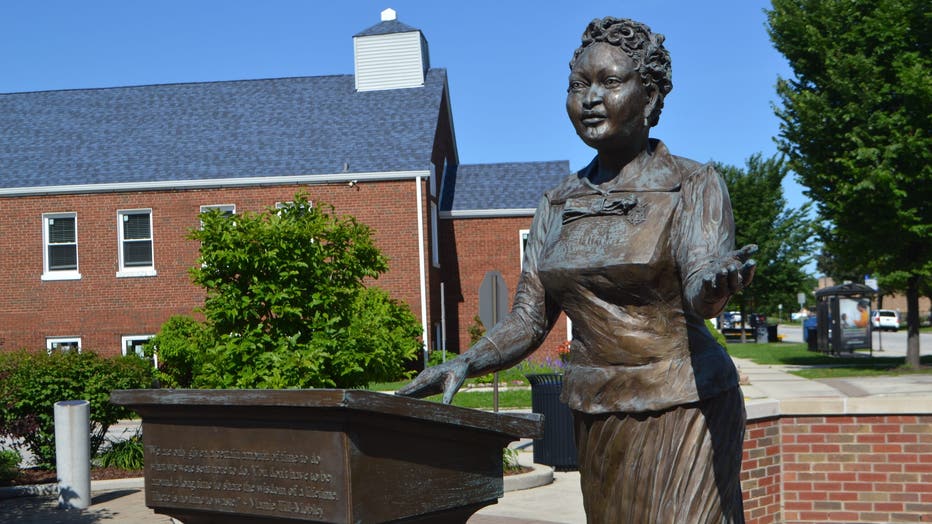
A statue of Mamie Till-Mobley, the mother of Emmett Till, stands on the campus of Argo Community High School. (Fox Chicago)
But of course, history is not a straight line of progress.
The country’s debates over its past and what it owes to Black Americans continue.
Even decades later, many have drawn comparisons of Till's murder to the slayings of other Black boys and men by law enforcement and vigilantes.
After the murder of George Floyd under the knee of a Minneapolis police officer in 2020, millions around the world protested. It was a brief moment of hope that the country would finally grapple with the consequences of its history.
"If someone is going to put together pictures of George Floyd with Emmett Till right on the web, what are they saying?" Gorn, the history professor, said. "They're saying, what just happened is very similar to what happened a couple of generations ago. This hasn't changed, or at least some version of this hasn't changed."
At the bill signing ceremony on Thursday, State Sen. Elgie R. Sims Jr. (D-Chicago) called memory an "act of justice" and spoke of the responsibility that comes with remembrance to future generations.
"It’s too late for Emmett Till. It’s too late for Breonna Taylor. It’s too late for George Floyd. It’s too late for Laquan McDonald, but it’s not too late for the children who are growing up today," he said. "It’s not too late to teach the truth. It’s not too late to demand justice. It’s not too late to choose courage over silence."
Still, Gorn warned against overly simplistic narratives. He said events in history are never exactly alike and agreed with the quote attributed to Mark Twain about how history doesn't repeat itself, but it "often rhymes."
If one stanza of history speaks of racial justice and protest, often the next will describe the inevitable reactionary backlash.
Just a few years after the mass protests of 2020, the political backlash to the nation’s so-called "racial reckoning" has taken form.
The second Trump administration has touted its effort to end what it called the "madness" of diversity, equity, and inclusion policies in the federal government.
Just this past April, the Supreme Court’s conservative majority struck down key provisions of the Voting Rights Act that aimed to preserve Black and Latino electoral districts. The law was signed by President Lyndon B. Johnson a decade after Emmett Till’s murder.
Longstanding inequities also persist.
White households still hold 10 times the amount of wealth that Black households have, according to the U.S. Census Bureau.
Black Americans make up just 14% of the U.S. population, but 42% of its incarcerated population, according to the Prison Policy Initiative.
In Chicago, residents of largely Black neighborhoods like Woodlawn, where Till and his mother lived in 1955, have a life expectancy close to a decade shorter than residents in wealthier, largely white neighborhoods on the North Side, according to the Chicago Health Atlas.
One wonders what Emmett Till today, with the benefit of 85 years of life experience, would have thought about his country.
"You see how far we've come, and how much work we gotta do," Parker said.
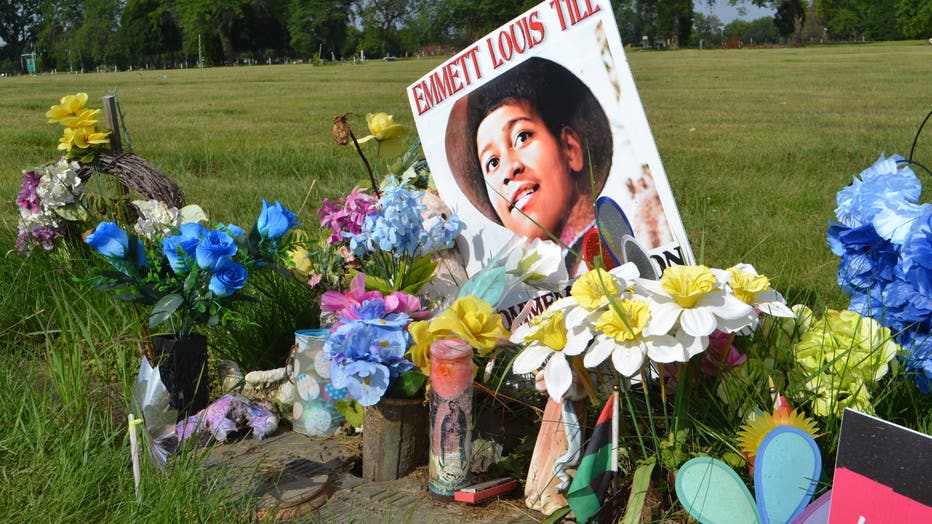
Flowers adorn the grave site of Emmett Till at Burr Oak Cemetery in Alsip, Illinois. (Fox Chicago)
Bobo
Till was buried in Burr Oak Cemetery in south suburban Alsip.
On a recent summer morning, his gravesite sat adorned with flowers, stuffed animals, small toy cars, and a sign with a photo of Till wearing a hat and a partial smile, appearing to look off in the distance with youthful, hazel brown eyes.
A yard sign on the ground read: "I hear you. I see you. I stand with you."
Today is Emmett Till’s birthday. He should have turned 85 years old.