

Economists don't anticipate reopening US to Mexican cattle imports to lower rising beef prices
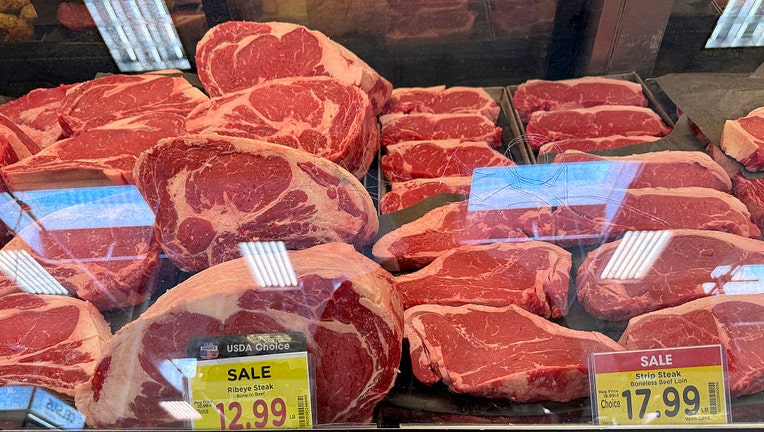
FILE-Cuts of beef are displayed at a grocery store on April 06, 2026 in Los Angeles, California. (Photo by Justin Sullivan/Getty Images)
Economists are skeptical that the United States reopening a border crossing in Arizona to cattle from Mexico on Monday as part of a bigger effort by the Trump administration to lower soaring beef prices.
Department of Agriculture officials told The Associated Press that it had concerns about the New World screwworm’s spread diminishing enough to allow the movement of cattle from Mexico at a crossing in Douglas, Arizona.
RELATED: Beef prices in focus as Trump signs order aimed at consumer relief
Officials added that they’re optimistic that it eventually hopes to reopen other crossings in New Mexico and Texas.
In 2025, the Trump administration closed the border to cattle imports to address the screwworm, a parasite with flesh-eating larvae that can infest and even kill cattle or other animals.
According to the AP, the action came as the U.S. has struggled to meet beef demand because of a cattle herd that dropped for five years.
USDA says the reopening starts at a safe spot
Dig deeper:
The federal government and industry officials view the New World screwworm fly as a threat to the nation's $113 billion cattle industry.
According to The Associated Press, the screwworm fly was contained for years near the Panama Canal but returned to southern Mexico in 2024 and advanced to the U.S., with the first case in Texas since 1966 reported June 3.
RELATED: Beef prices soar as American families pay steep prices for steaks and burgers nationwide
Since that time, approximately 40 cases have been confirmed in southern Texas and southeastern New Mexico, with infestations of cattle, sheep, goats and dogs.
U.S. Agriculture Secretary Brooke Rollins said in July that it was possible to start with an Arizona crossing because the northern Mexican states of Sonora and Chihuahua had stronger animal health programs than other parts of Mexico.
The AP noted that Rollins said each animal would be examined and declared free of the parasite before crossing the border.
On Jan. 1, the U.S. Department of Agriculture reported that the U.S. cattle herd dropped to 86.2 million head.
Beef prices surged over the past five years, rising substantially faster than food prices, according to the U.S. Bureau of Labor Statistics.
Additionally, the average price of a pound of ground beef increased almost 57% from July 2021 to July 2026, from $4.39 to $6.89 — hitting a peak of $6.90 in May — with a 10% increase over the previous year. Food prices have risen about 25% overall in those five years, according to agency numbers.
The price for a pound of uncooked steak increased 35% over the past five years, reaching a record $13.06 per pound in July.
The Source: Information for this story was provided by The Associated Press, which cites comments from the U.S. Department of Agriculture and data from the Bureau of Labor Statistics. This story was reported from Washington, D.C.