

3I/ATLAS comet is not an alien spaceship, scientists confirm

3I/ATLAS update: NASA unveils close-up pictures
The interstellar object 3I/ATLAS has piqued the curiosity of space enthusiasts around the globe, and NASA offered new images with more information Wednesday of what they say is a comet. LiveNOW’s Austin Westfall is speaking with Astronomy Professor Ken Gayley from the University of Iowa after NASA provided more images and details during a live event on Wednesday.
The 3I/ATLAS comet that captivated the masses when it was first discovered last summer is not an alien spaceship, scientists have confirmed.
Just a regular comet
When the 3I/ATLAS comet made its closest approach to Earth on Dec. 19, 2025, Breakthrough Listen, an international group of surveyors who are hunting for intelligent life in the universe, said it conducted a "technosignature search" toward the cosmic object.
A technosignature is any detectable signatures and signals of the presence of distant advanced civilizations, according to NASA.
What they're saying:
"We all would have been thrilled to find technosignatures coming from 3I/ATLAS, but they're just not there," lead researcher Benjamin Jacobson-Bell from the University of California, Berkeley, told Space.com. "Finding no signals was the result we expected, due to the significant evidence for 3I/ATLAS being a comet with only natural features.
"The evidence was against 3I/ATLAS being one such probe, but we would have been remiss not to check."
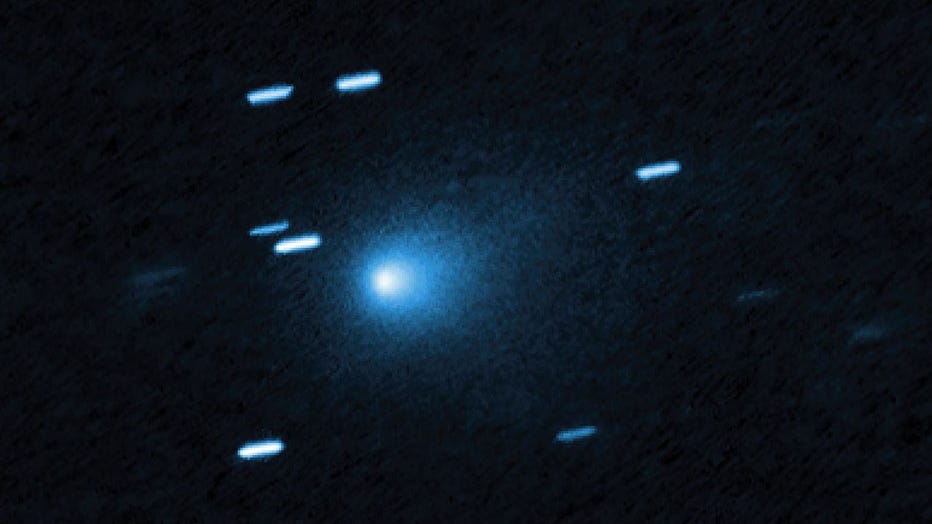
Hubble captured this image of the interstellar comet 3I/ATLAS on July 21, 2025, when the comet was 277 million miles from Earth. Hubble shows that the comet has a teardrop-shaped cocoon of dust coming off its solid, icy nucleus. Image: NASA, ESA, Dav
Dig deeper:
Using the Robert C. Byrd Green Bank Telescope at the Observatory in Green Bank, West Virginia, researchers said there were no signals down to the 100mW level, according to the study which was submitted in December 2025 but has yet to be peer-reviewed.
This means that researchers looked for signals that were about as strong as a modern cellphone.
"When we conduct searches for artificial electromagnetic emission, like radio signals or laser signals, we are only sensitive to signals that are above a certain power output. It is easier to detect signals that are more powerful. Just like if you are trying to hear someone talking to you in a crowded restaurant, it helps if they yell," Andrew Siemion, director of Breakthrough Listen at the University of Oxford and one of the authors on the study, told FOX Local.
This does not mean, however, there are absolutely no signals coming from 3I/ATLAS, but there just aren’t any stronger than 100mW levels.
"Thus we cannot say categorically that there are no radio transmitters (or other kinds of transmitters) on this object. We can only say that there are none more powerful than 100 milliwatts that were transmitting in the range of frequencies we searched, at the time we searched," Siemion added.
What is the 3I Atlas comet?
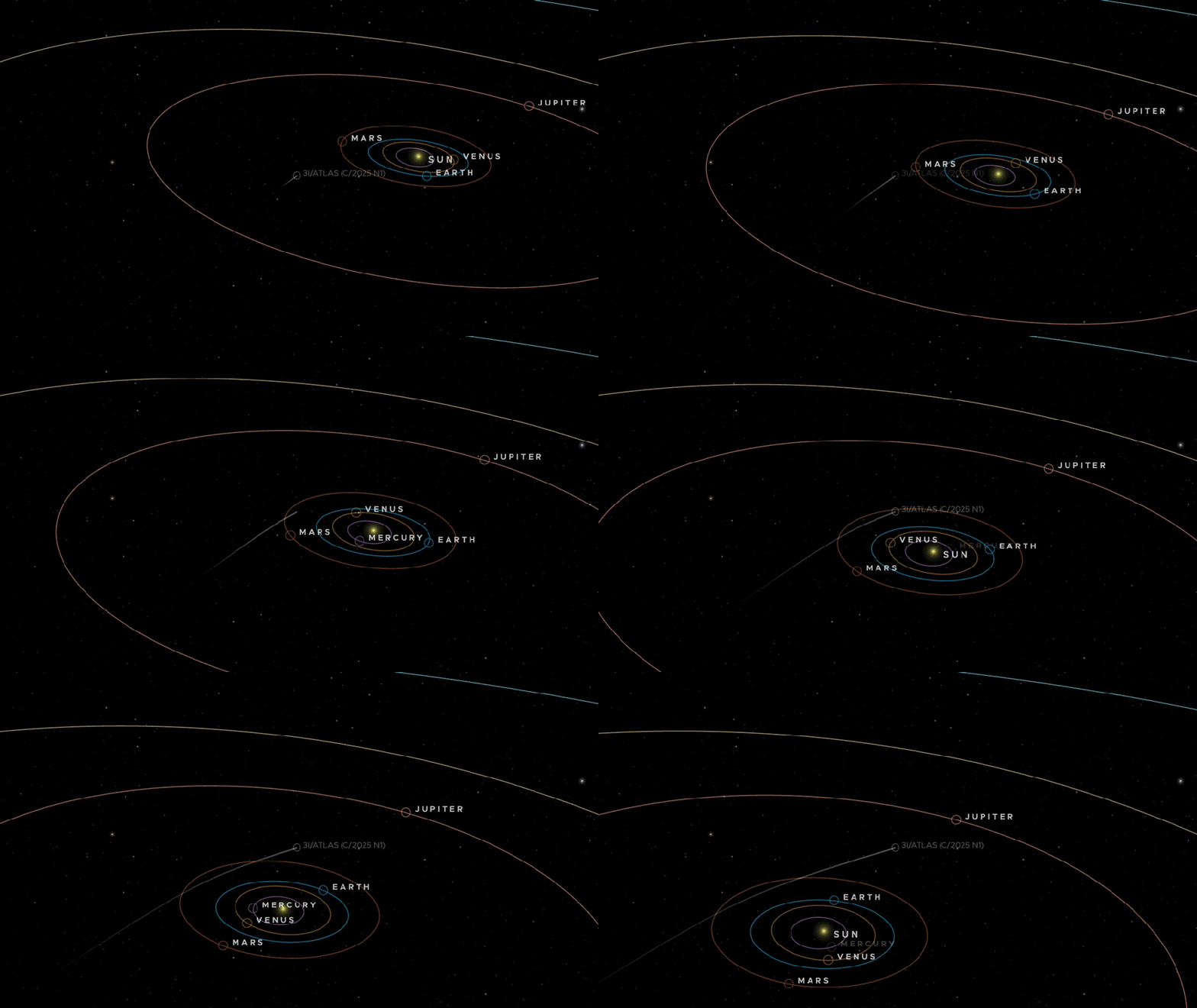
Animation of comet 3I/ATLAS's trajectory through our solar system. (NASA/JPL)
The comet known as 3I/ATLAS entered our solar system last year. It got its name because it is the third interstellar object known to have visited our solar system (3I), and because ATLAS was the telescope in Chile that discovered the object, according to Harvard astrophysicist Avi Loeb.
Timeline:
The comet was discovered on July 1, 2025, out near Jupiter. Scientists say it was discovered early during its journey through our solar system, giving experts ample time to watch and study the icy snowball.
Earlier in October, the comet approached Mars and came within 18 million miles of the red planet.
Right now, it’s making its closest approach to the sun, which NASA predicted would happen in late October.
Throughout November, the European Space Agency’s Juice spacecraft, which is headed to Jupiter and its icy moons, will keep an eye on the comet.
And then in December, it will swing back and be at its closest to Earth — though still about 167 million miles away.
RELATED: Earth has a new temporary mini-moon: Meet 2025 PN7
Local perspective:
The comet had been visible by telescope through September, before it got too close to the sun, and is likely to reappear in December on the other side of the sun.
The Hubble Space Telescope captured a picture of the comet back in August.
Images revealed a teardrop-shaped plume of dust around the nucleus as well as traces of a dusty, extending tail.
By the numbers:
Observations by the Hubble Space Telescope put the comet’s nucleus at no more than 3.5 miles across. It could be as small as 1,444 feet, according to NASA.
The Source: Information for this article was taken from emailed questions with Andrew Siemion, the director of Breakthrough Listen at Oxford University, a study submitted on Dec. 20, 2025 to arXiv, reporting by Space.com and previous reporting by LiveNOW from FOX. This story was reported from San Jose.