

AI is reshaping how meteorologists forecast the weather
AI reshapes how meteorologists forecast weather
Will AI replace meteorologists? Experts weigh in on the future of forecasting.
CHICAGO - If you’ve checked the weather lately, artificial intelligence may have played a role.
Chief Meteorologist Emily Wahls explains how AI could change the way we forecast the weather.
What we know:
AI is not-so-quietly becoming one of the most powerful tools in today’s society, and it’s no different in the science community. Meteorologists rely on physics-based computer models to predict the weather. But major advances in AI could make those forecasts faster and even more accurate.
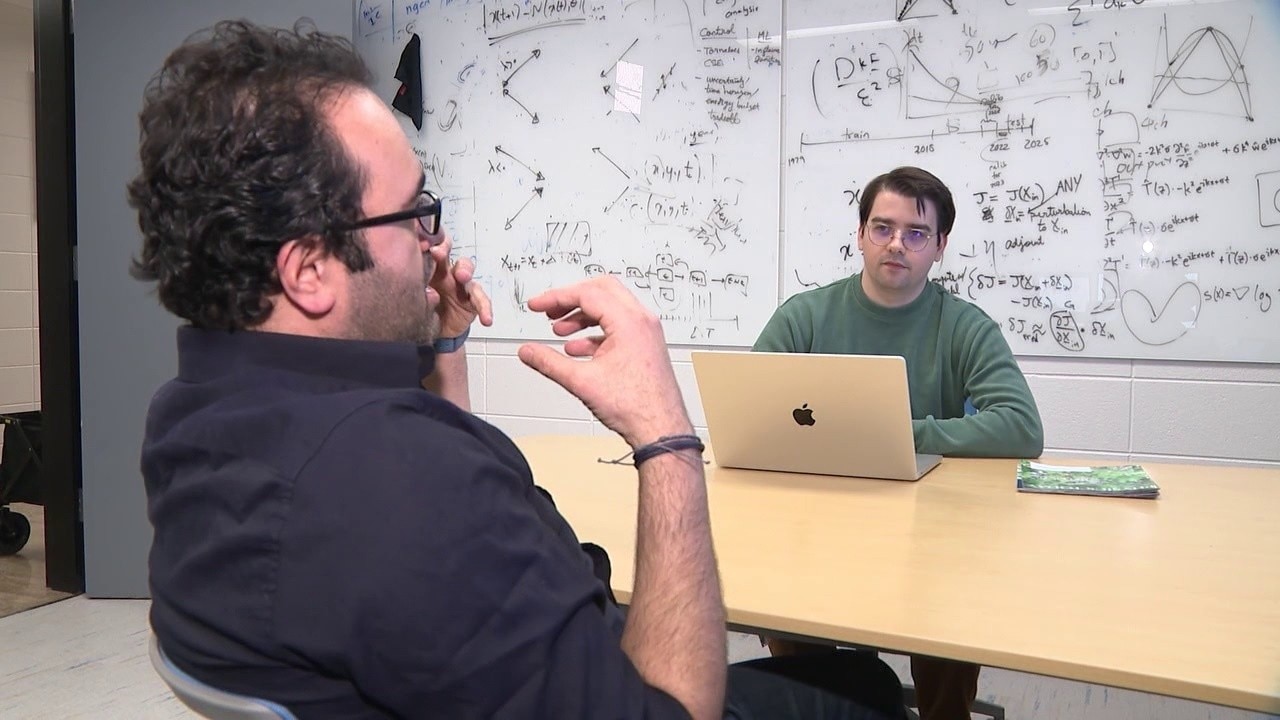
Pedram Hassanzadeh is an associate professor of geophysical sciences and computational applied math at the University of Chicago. In 2017, Hassanzadeh began researching AI, particularly deep learning, to investigate how AI models can be used to improve weather and climate prediction. He calls AI the second revolution in weather forecasting.
"It’s completely changing how we do weather forecasts, right, rather than solving some equations on a computer, we are just using data with a neural network, right? But doing this, you actually get better accuracy, and everything is much cheaper, much faster," Hassanzadeh said.
As it stands now, the limit of predictability with the commonly used physics-based models is around eight days. Hassanzadeh says the AI model expands the limit of predictability out to nine days. That may not sound like much, just one extra day, but the real breakthrough is speed.
These AI models can generate forecasts up to 100,000 times faster. So the advantage then becomes that you can generate many forecasts in the same amount of time. This shrinks the cone of uncertainty.
Dig deeper:
So you may be wondering: Is the need for human meteorologists going away?
"I think actually now even there is a higher demand for meteorologists and people who, that’s what we are trying to do in this department. So we are try to teach the students to, of course, still know the fundamentals, but also know AI and how this can come together, because I totally agree at the end of the day to improve these models, even make better models, and also to properly use the current models, we certainly need experts to be in the loop," Hassanzadeh said.
Think of forecasting as a team sport.
"Exactly. And frankly, it has been like that for a long time, like even around the Second World War, as I mentioned, when it was really mathematicians, computer scientists, and meteorologists who worked together to get things to work on the first computer to do weather forecasting. But I think now we are back to, again, we need computer science, stat, math, and meteorology to work together, to make the best use of these AI models. AI models can be customized in ways traditional physics-based models can’t," Hassanzadeh said.
We also spoke with Alexander Wichner, an Eric and Wendy Schmidt AI and Science Fellow at the University of Chicago, who took a hybrid approach to predict the probability of extreme heat hitting Chicago.
"One of the biggest benefits that I see for AI forecasting models is that they can be much more flexible in terms of the type of data that they could be trained on when compared to the type of data that you might be able to input into a physics-based model. So that not only gives them the capability to perform very good global forecasts, but it also means that they can potentially be tailored to produce very good forecasts in specific regions or for specific use cases where people might have certain types of data that they might not have been able to use before but that can be used by an AI model to produce good forecasts," Wichner said.
Big picture view:
Weather impacts just about everything and everyone. Hassanzadeh’s latest research efforts have been to help farmers in India be able to track monsoons using AI. A good weather forecast is also crucial to things like aviation, shipping and public safety.
The latest developments in AI could help forecasts become not just faster, but more useful.
And for those of you who may be wary:
"So I would say that in terms of the metrics of accuracy that we’ve been largely using to evaluate weather forecasting, models have already shown that they can match or improve upon the accuracy of physics-based models. That’s not to say that there aren’t some potential risks in using these models. We do need to keep this problem of potential gray swan events that the models may not have seen during training in the back of our heads that if we’re trying to use them to predict extreme weather, we should still be balancing what they see with a physics-based model because the AI model might miss something. But overall, for most everyday weather forecasting tasks, these models seem to be doing very well, and they’re likely going to be more and more incorporated into our forecast going forward," Wichner said.
The Source: The information in this story was reported by FOX Chicago's Emily Wahls.