

Questions surround FAA spending as it seeks $50 billion in funding after already receiving billions
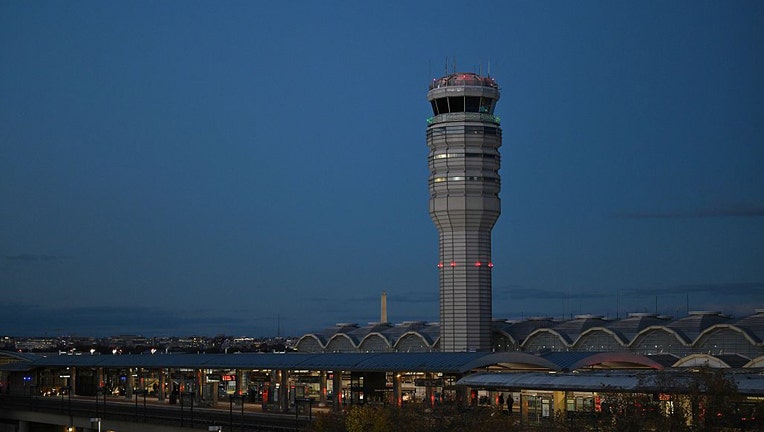
FILE-The Ronald Reagan Washington National Airport air traffic control tower in Arlington, Virginia, the United States. The U.S. Federal Aviation Administration FAA issued a nationwide ground stop on Friday following a "communication issue impacting
The Trump administration is pushing for $50 billion for an aging air traffic control system after problems with routers seemingly resulted in a nationwide grounding of planes on Nov. 13.
Investigators are still working to determine what caused the travel disruption, which was lifted on Nov. 13. With travel expected to return to normal on Monday, the Associated Press reported that Transportation Secretary Sean Duffy alluded to travel expected to return to normal operations by the end of Monday or Tuesday.
President Donald Trump weighed in on Nov. 15 with comments on his Truth Social platform criticizing his Democratic predecessor and calling for more money to pay for improvements to the system.
RELATED: Nationwide ground stop lifted, but delays will linger
Congressional Democrats told The Associated Press that they also want to upgrade the nation’s older air traffic control system. However, they are questioning the price tag.
Democrats on the House Transportation Committee said most of the money appropriated last year remains unspent.
Duffy detailed what is known — and still unclear — about the problems that led up to his decision Friday to ground the planes, as he also urged Congress for billions more to improve a system he claims has been neglected for years.
What happened with the FAA ground stop?
What they're saying:
Transportation Secretary Sean Duffy explained in an X post on Nov. 13 that the issue started when a federal contractor was replacing a section of old copper wire with new fiber wire, causing the system to overload.
After the wire was replaced at the site in El Dorado, Arkansas, and the router was turned
on, a problem then cropped up at a facility in Amarillo, Texas, cascading into the ground stop.
The Federal Aviation Administration (FAA) said in a statement obtained by The Associated Press that "excessive data" was flooding the system "at a rate of 1,000 connection attempts every 4 to 5 seconds."
RELATED: FAA ground stop: What are your rights if you’re stuck on the tarmac?
That flood led to instability with "aircraft communications and radar feeds," the agency said. The contractor blocked the two locations in Arkansas and Texas, and the agency said that stabilized the network.
Duffy noted that billions are needed to build a "brand new architecture" for the network and said companies — including AT&T, Verizon and Lumen — are ready to deploy it "tomorrow" if the money is there.
Aging air traffic control system has been an issue for years
Dig deeper:
The urgency to improve the nation’s air transportation system is an effort that Congress has dedicated substantial amounts of resources to in recent years.
During President Joe Biden’s term in office, Congress approved a massive infrastructure bill that included $25 billion over five years for airport and air traffic control infrastructure improvements.
According to The Associated Press, most of the money was allocated to airports for new runways and taxiways, and new and refurbished terminals.
Under the Trump administration, a Republican-led Congress approved $12.5 billion in 2025 to modernize the FAA’s air traffic system. The administration stated that the money would provide significant updates to outdated radar systems and traffic control centers.
The AP reported that Republicans used the same bill to distribute $170 billion for President Donald Trump's immigration enforcement.
Moreover, the Federal Aviation Administration upgrade has two phases. The first, funded by the $12.5 billion, is to be completed by December 2028.
A second phase involves building new systems to monitor aircraft and maximize traffic. FAA Administrator Bryan Bedford told legislators in September that the second phase will cost roughly an extra additional $10 billion.
The Source: Information for this story was provided by The Associated Press, which cites a statement from the Federal Aviation Administration, and social media posts from President Donald Trump and Transportation Secretary Sean Duffy. This story was reported from Washington, D.C.