

How Indiana football became a national power in the new age of college sports: Telander
CHICAGO - Let's see, this was November 12, 2006, during Dad's Weekend for sororities at Indiana University, a cold, crisp Saturday designed for college football. My daughter Robin was a sophomore, and I visited with a bunch of other dads from all over, and the main thing was to have fun and see what it was our kids were doing.
One thing we found out was that, besides studying hard, they were partying. Thus, we went to "The Field," the grassy, tree-lined area across from Memorial Stadium.
People were tailgating and having a great time there. The partying went on, the game started across the way, Hoosiers vs. Michigan Wolverines, and most people, who no doubt had tickets to the game, just kept doing what they were doing.
Hoosier football? Who cares? Par-tee!
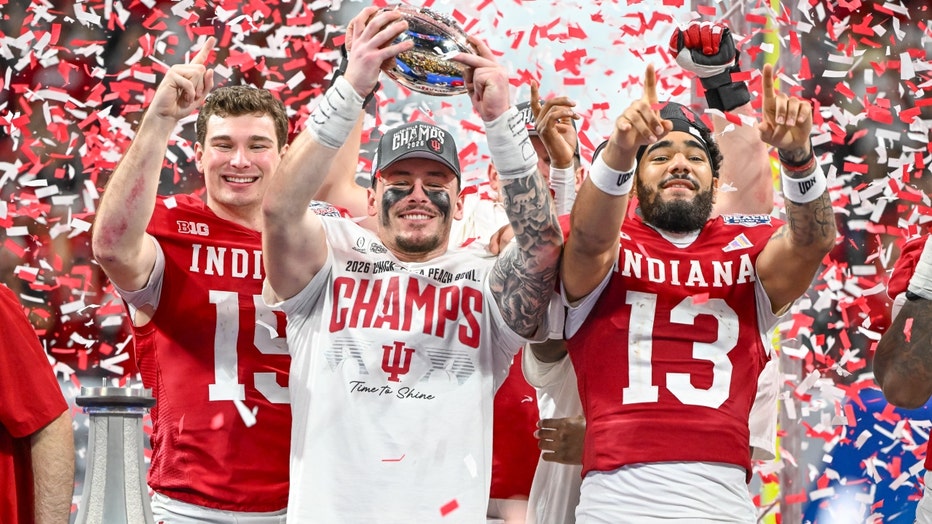
QB Fernando Mendoza #15 (left) with LB Aiden Fisher #4 (center), and WR Elijah Sarratt #13 (right) of the Indiana Hoosiers hoist the Chick-fil-A Peach Bowl Trophey after the Indiana Hoosiers versus Oregon Ducks College Football Playoff Semifinal at t (John Adams/Icon Sportswire via Getty Images / Getty Images)
Okay, that was then.
Now? The 15-0 Hoosiers are playing for the College Football Playoff National Championship against the Miami Hurricanes on Monday night, and tickets are going for $3,000 for the worst seats at Hard Rock Stadium. Fifty-yard line seats are $14,000; the best suites, $1 million.
There are open areas around the stadium in Miami Gardens, Fla., but it's for dang sure no Hoosier fans will be hanging out there once the game starts. (That is, if they could even afford a ticket.)
So what happened? How did the Hoosiers, who have never won or even played for a football national championship in their 138-year gridiron history, become the No. 1 team in the country and the biggest draw since, well, who knows when?
Miami, down a bit in recent years, still has won five national crowns since 1983. The Hoosiers haven't even won a Big Ten title in that time. In fact, until new coach Curt Cignetti came to Bloomington two years ago, the Hoosiers had won but a single conference championship since World War II. And that came 58 years ago, in stunning, last-second fashion led by thrilling quarterback Harry Gonso (great name, or what?) and halfback and punter, John ("Punt, John, Punt!") Isenbarger.
That 1967 Rose Bowl team came and went so fast, it might as well have been a tequila shot in The Field. Poof. Gone. The year before, the Hoosiers had finished 1-8-1. Three years later, they went 1-9.
Indiana's a basketball state. Its football record proves it. But then Cignetti came from James Madison on November 30, 2023, and the Hoosiers are 26-2 since. Cigs was asked why good players would consider playing for him.
"Because I win," he answered.
Man, is that true. In four years as a head coach—two at James Madison, two at Indiana—Cignetti is 45-6. His quarterback this year, the ebullient, ever-smiling, God-praising Fernando Mendoza, is Indiana's first Heisman Trophy winner ever. And the 6-5 field general deserves it. In the Hoosiers' two playoff games, Mendoza has more touchdown passes (eight) than incompletions (five) and no interceptions.
His completion rate for the regular season was a ridiculous 73.0 percent. In the playoffs, it’s an insane 86.1 percent. The guy is riveting to watch with his precision and touch, but he's even more fantastic in post-game interviews when he sounds like a coach, an analyst, and an excitable kid who just won free rides on the Ferris wheel for life.
But here's the thing about Indiana football. It's a phenomenon that arrived because the new world of college football arrived. Name, image and likeness, money and school payouts have made former "student-athletes", quite simply, pros. Some, mercenaries. Mendoza is rumored to be making $2 million this year. His counterpart at Miami, quarterback Carson Beck, reportedly is earning $4 million, with incentives that might get him to $6 million.
Your team can change overnight. Remember, Mendoza had a nice career at Cal before coming to Indiana. Beck played five—yes, five—formative years at Georgia. Cignetti brought in transfers from James Madison and portal players left, right and sideways. Some of his guys might not even know where Bloomington is on a map. Star center Pat Coogan does, though. He played 30 games for Notre Dame, before moving a little south from South Bend, Ind.
No matter, really. New dudes will arrive next fall. Over 4,700 college football players entered the recent transfer portal, over a third of all D-1 players. Star quarterbacks come and go like squirrels in an acorn plant. Such is new college sport. From such came Indiana football.
Indiana's early start in the "student-pro" derby might not last. It might even have severe money consequences for IU down the road. Consider Colorado sold its soul to hustler Deion "Coach Prime" Sanders for his two sons and an eventual Heisman Trophy winner three years ago. CU filled its stadium to bursting for a spell, had wild student and alumni hoopla, and now—with Shedeur, Shilo, and Travis Hunter gone, and Coach Prime just signed to a $10 million-a-year, five-year deal--finds its athletic department $27 million in debt.
Oopsie.
"College football's changed a lot," Cignetti stated Monday. "You've got to adapt, improvise, be light on your feet if you're going to survive."
So go, IU! Win it all. Worry about the aftershock if and when it happens.
Me, I'd be light on my feet these days and trot across the street to Memorial Stadium for any game. I asked my daughter if she’d leave the partying at The Field for the same, knowing what she knows now.
"Me? No way," she said.
College educated, for sure.
Dig deeper:
Want more? Read some of Rick Telander’s recent columns for Fox 32:
- For the Bears, the whole season comes down to one more game against the Packers: Telander
- Caleb Williams is electric - but are the Bears asking too much too soon: Telander
- How Notre Dame should fit itself into he Wild West of college football | Telander
- With Packers looming, Caleb Williams looks like the quarterback Chicago has waited 75 years for: Telander
- Notre Dame's playoff snub could trigger seismic shifts across college football: Telander
The Source: This article was written by Rick Telander, a contributing sports columnist for FOX 32 Chicago.