

Tariff refunds: Who's getting them and when will they be issued?
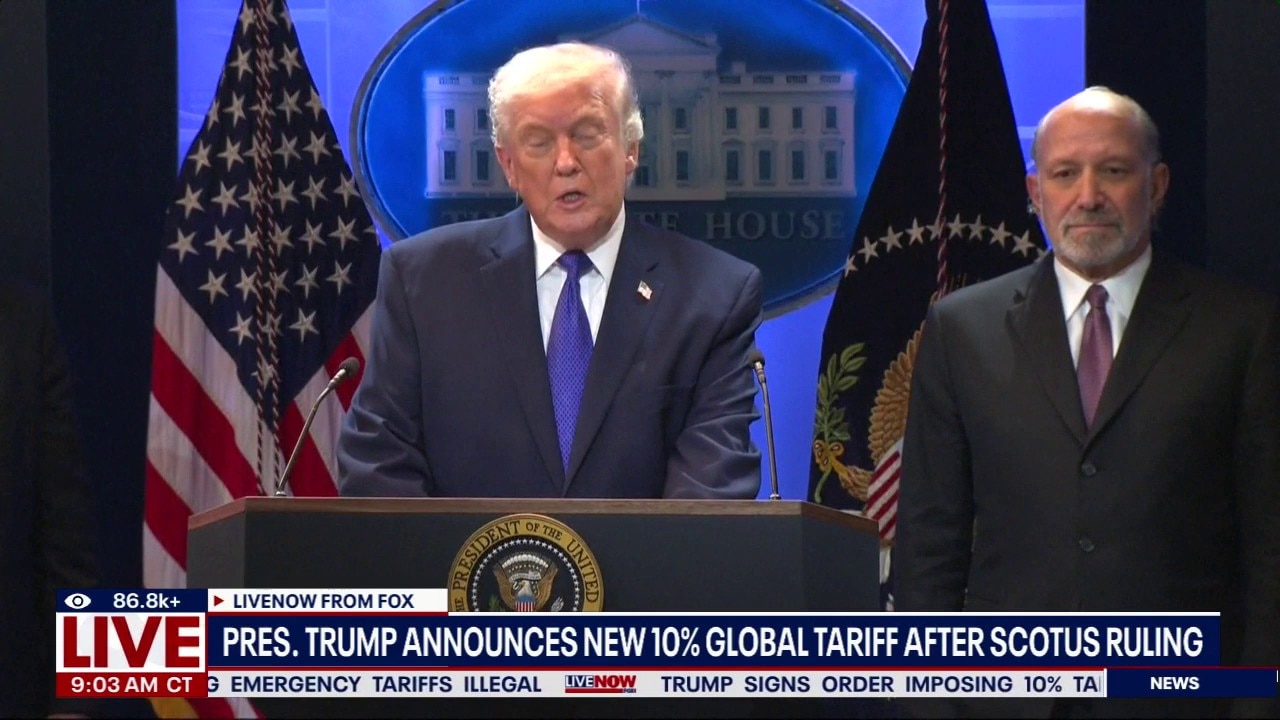
Expert weighs in as Trump imposes more tariffs.
The Supreme Court struck down President Donald Trump’s global tariffs on Friday. Trump said he was "absolutely ashamed" of some justices who ruled 6-3 against him, calling them "disloyal to our Constitution" and "lapdogs." The president also pledged to impose a new global 10% tariff under a law that’s restricted to 150 days and has never been used to apply tariffs before.
The Supreme Court ruling that struck down most of President Donald Trump’s tariffs Friday has left unanswered questions: Will the money already collected by the government be refunded? And if so, who’s getting their money back?
Trade experts say the amount of money raised from Trump’s tariffs is substantial – $133 billion – and companies are already lining up for refunds. Here’s the latest:
Tariff refunds
What we know:
The 6-3 Supreme Court opinion ruled that Trump’s attempt to use the 1977 International Emergency Economic Powers Act (IEEPA) to enact the taxes is not valid. That power belongs to Congress, the justices said. But the high court ruling said "nothing about whether, and if so how, the Government should go about returning the billions of dollars that it has collected from importers," Justice Brett Kavanaugh, who voted in favor of the tariffs, wrote in his dissenting opinion.
RELATED: Supreme Court rules Trump's tariffs violated federal law
Trade lawyers say importers who want refunds should anticipate a lengthy and potentially convoluted process for getting their money back. The process is likely to be handled by a mix of the U.S. Customs and Border Protection agency, the specialized Court of International Trade in New York and other lower courts, according to lawyers at the legal firm Clark Hill.
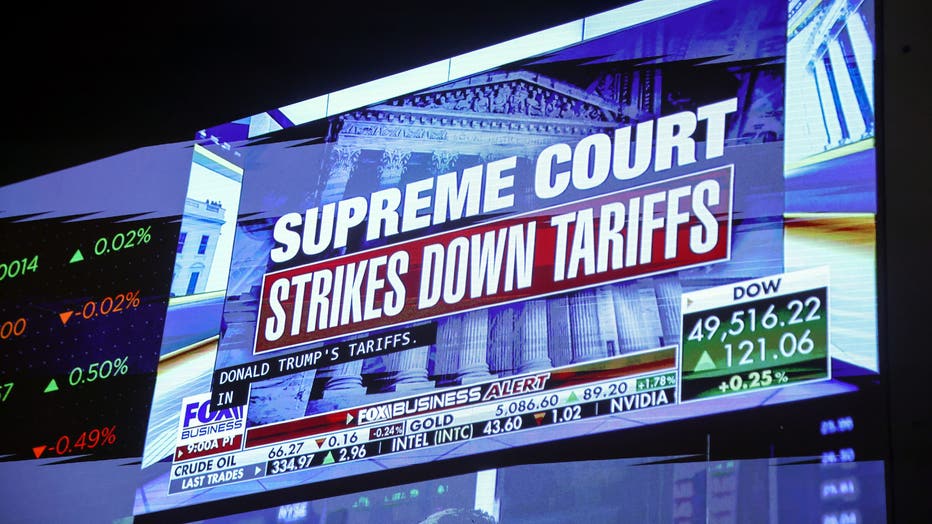
A television broadcasts news about the Supreme Court striking down President Trump's global tariffs on the floor of the New York Stock Exchange (NYSE) in New York, US, on Friday, Feb. 20, 2026. Photographer: Michael Nagle/Bloomberg via Getty Images
The U.S. customs agency does have a process for refunding duties when importers can show there’s been an error, and there’s precedent for courts making arrangements to give companies their money back in trade cases. But the courts and U.S. customs have never had to deal with anything like this — thousands of importers and tens of billions of dollars at once.
What they're saying:
"The government is well-positioned to make this as difficult as possible for importers. I can see a world where they push as much responsibility as possible onto the importer," trade lawyer Joyce Adetutu, a partner at the Vinson & Elkins law firm, told The Associated Press. "It’s going to be a bumpy ride for a while."
What does Trump say about refunds?
What we don't know:
It’s still unclear what the refund process will look like, or whether importers will have to sue the federal government to get their money back. A defiant Trump said Friday that "I guess it has to get litigated for the next two years."
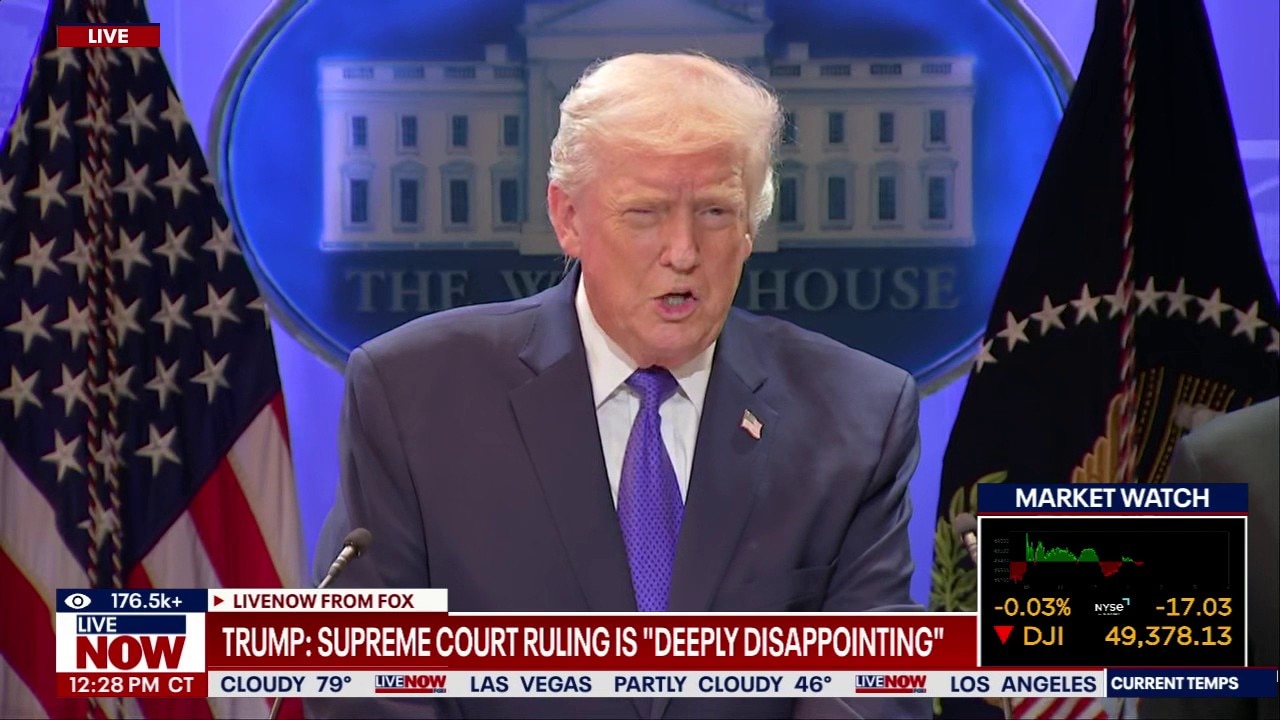
President Trump: SCOTUS ruling is 'deeply disappointing'
President Donald Trump called the SCOTUS ruling on tariffs, "deeply disappointing." The Supreme Court ruled in a 6-3 decision that Trump did not have authority to issue sweeping tariffs.
"Just because the process is difficult to administer doesn’t mean the government has the right to hold on to fees that were collected unlawfully,″ said trade lawyer Alexis Early, partner at the law firm Bryan Cave Leighton Paisner.
Timeline:
If refunds are issued, TD Securities estimates it will take 12 to 18 months to return the money.
Will consumers get a tariff refund?
Dig deeper:
According to a January report from the Kiel Institute for the World Economy, the tariffs Trump enacted have mostly been paid by American importers and consumers. But consumers shouldn’t get their hopes up for a refund: Any refunds issued are more likely to go to the companies that paid the import taxes. The higher prices consumers have had to pay would likely be hard to attribute to a specific tariff, experts say.
RELATED: U.S. tariffs mostly paid by American importers and consumers, report suggests
Some Democrat-led states, however, have already announced their plans to seek refunds.
What SCOTUS decision means for tariffs
The Supreme Court has struck down President Trump's major tariffs policies, which are a huge piece of his economic agenda. We'll discuss what it all means with Cayce Myers.
Illinois Gov. JB Pritzker, a Democrat and Trump antagonist, is demanding a refund on behalf of his state's 5.11 million households. In a letter addressed to Trump and released by Pritzker's gubernatorial campaign, the governor said the tariffs had cost each Illinois household $1,700 — or $8.7 billion. Pritzker said failure to pay will elicit "further action.''
Nevada Treasurer Zach Conine submitted a payment request to the federal government for $2.1 billion to recoup the costs of the tariffs, his office announced Friday.
Will tariff refunds help the economy?
Big picture view:
Experts say ending the tariffs struck down by the Supreme Court could help the economy by easing inflationary pressures. Tariff refunds could also stimulate modest spending and growth.
RELATED: Trump enacts 10% global tariffs in response to Supreme Court decision
But most countries still face steep tariffs from the U.S. on specific sectors, and Trump said he’s replaced the IEEPA tariffs with a 10% tax on imports from around the world. Trump said he signed an executive order that allows him to bypass Congress and impose the new tariffs. The new tariffs come under a law that restricts them to 150 days.
The Source: This article includes information from the legal firm Clark Hill, the Kiel Institute for the World Economy, trade lawyer Joyce Adetutu, trade lawyer Alexis Early, TD Securities, The Associated Press and previous FOX Local reporting.