

'You couldn’t do this out in the street': Inside all the parts of the Chicago Bears' physical blocking game

Bears' offensive line continues to impress | Chicago Sports Tonight
The Chicago Bears offense continues to impress, but can they keep up the momentum against the Packers this weekend? Former Bears offensive lineman Steve Edwards joins CST.
On Thursday, two days before the biggest game of his young head coaching career, Ben Johnson tried to simplify it all.
The Chicago Bears vs. Green Bay Packers is no different from any other week.
That’s not entirely true. In Week 16, the NFC North division crown could be on the line with this one. But, Johnson knows that.
What he means is the goals aren’t different: execute the game plan, and win the game. The lights might be brighter, but the game is the same.
For the 2025 Bears, that goal is to use smash-mouth football and take the football away. The former is what drives the Bears’ offense. The running game, featuring D’Andre Swift and Kyle Monangai, averages 151.9 rushing yards per game, second in the league behind the Buffalo Bills.
That offense has worn opponents down and led to wins.
"You kind of just keep chipping away and eventually, holes start opening up a little bit more wider," Darnell Wright said after the Bears beat Cleveland 31-1. "The running backs start running through more and more arm tackles."
The running game has stemmed from the Bears winning at the point of attack, where blocking has become something close to an explosive play.
"All we talk about as coaches is just focus on the little things, the details, still about blocking and tackling and catching and pursuing," Johnson said Thursday. "All the boring stuff to the casual observer is everything that us coaches preach and look for on game day."
If the Bears are to win the biggest game in years – perhaps in a decade – on Saturday, they’ll need to lean into the one detail the offense has seemingly mastered.
They mastered the art of blocking for Ben Johnson’s offense. That’s what can carry the offense into the postseason with three games remaining.
The Block Party:
Bears running backs coach Eric Bieniemy has seen the moments when the run game begins to click. But, it’s not something that’s measured throughout a game.
Instead, Bieniemy pointed to what's happening in front of the running backs, starting with the offensive line.
"Those guys may not get the credit they deserve," Bieniemy said. "More important, our receivers and tight ends are also doing an outstanding job."
Blocking in Ben Johnson’s offense is a collective effort. There’s not one aspect that’s more important than the other. That’s because every player involved has specific blocking assignments.
The tight ends play a large part in this. Johnson has started both Cole Kmet and Colston Loveland every game this year, showcasing his penchant for a 12-personnel offense, which is a two-tight-end set. Recently, it’s involved more three-tight-end sets.
Tight ends coach Jim Dray said it’s a "privilege" when the Bears can run 13-personnel with three tight ends, and the chance to be multiple out of 13-personnel is what leads to points.
"You kind of earn the right," Dray said. "The more success we have over those personnels, the more coach wants to put it out there so we can keep doing it, keep executing efficiently and be explosive and score touchdowns."
However, it becomes the most multiple when the Bears establish the run.
That brings play-action plays into the fold, where the Bears can start moving players in motion and work formations to their advantage.
"We're under center, we are moving parts before the snap, at the snap, post-snap, whatever that may be," Bears passing game coordinator Press Taylor said. "There's just a lot of hesitation from the second level. So, whether it is play action, trying to get guys in behind, it opens up the run game just through the second level, being hesitant, being able to get to the second level, secure the first level first, whatever that may be."
Creating hesitation within the defense allows the Bears to have some form of a head start, be it a half-step head start or a full step. That way, the Bears are the aggressors at the point of attack. That starts with blocking properly in the run game.
"You just like the idea of we're able to do whatever we want and stay on the offensive, being able to dictate terms on normal downs against defenses," Taylor said.
Dictating their own terms specifically includes the wide receivers.
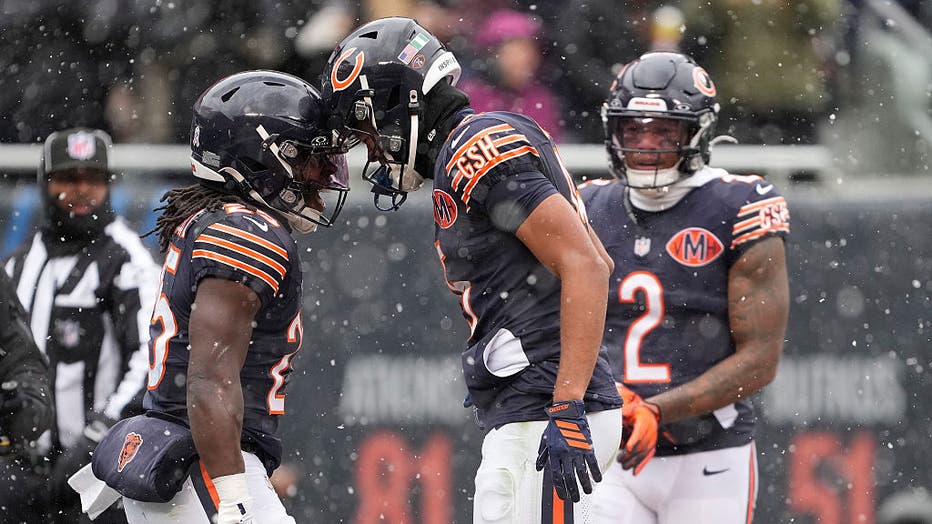
CHICAGO, ILLINOIS - NOVEMBER 09: Kyle Monangai #25 and Rome Odunze #15 of the Chicago Bears celebrate after a touchdown against the New York Giants during the first quarter in the game at Soldier Field on November 09, 2025 in Chicago, Illinois. (Phot
'No Block, No Rock':
The Bears set the tone early on in training camp when Johnson said that day was going to be physical.
On Aug. 5, the Bears had a camp practice that was so physical, it reverberated through the observing media to the rest of Chicago. There was tackling in the 7-on-7 periods and a goal-line period where you could hear the hits.
That’s the kind of nature Johnson requires. Wide receivers coach Antwaan Randle El made sure his receivers had the same nature when blocking for the Bears’ running game.
Specifically, Randle El made sure he knew his players knew that it wasn’t just encouraged to be physical as blockers, but that highly physical blocking is actually allowed.
"Man, it's legal," Randle El said he told the receiver room. "You get to do this. You couldn’t do this out in the street. Like, you get to this."
The main idea is to protect a teammate.
"He’s in your way. If not, he’s going to hit your homeboy," Randle El said. "That's the way I approach it."
But, throwing a physical block falls into the Bears’ creed. "No block, no rock," Randle El has preached since Day 1. But, when the Bears see a physical block in the running game, it’s similar to an explosive play.
Look no further than right guard Jonah Jackson’s block on Browns rookie Mason Graham last Sunday, where Jackson planted Graham into the Soldier Field turf on a trap play.
"I think that's contagious sometimes," Bears offensive coordinator Declan Doyle said. "You talk about the play that Jonah had, and to put that on tape and our guys to see that and see what that looks like and kind of embody the physicality that we want to play with, the brand of football that we want to embody. It's a positive because the things that we're preaching are showing up, week in and week out, and you're really starting to see our identity on tape and what we say we're going out and doing."
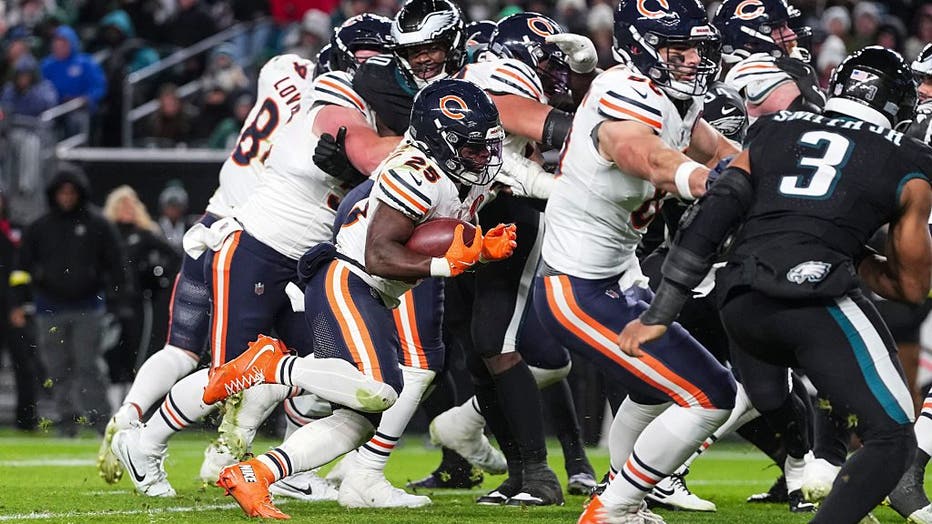
PHILADELPHIA, PENNSYLVANIA - NOVEMBER 28: Kyle Monangai #25 of the Chicago Bears runs the ball during an NFL football game against the Philadelphia Eagles at Lincoln Financial Field on November 28, 2025 in Philadelphia, Pennsylvania. (Photo by Perry
Big picture view:
The centerpiece of the block party is, of course, the offensive line.
Bears quarterback Caleb Williams named all of them after Marvel heroes, calling the group "The Avengers." This unit features a remade interior, which includes Jackson, Joe Thuney and Drew Dalman, with impressive play from Ozzy Trapilo at left tackle and Darnell Wright on the right side.
"There's a physicality about the group," Bears offensive line coach Dan Roushar said. "There's effort to finish."
The physical play has been a constant. While the Bears’ offensive front needed the first few weeks of the season to find cohesion, they’ve since mixed the physical identity into the process of formulating a game plan. It’s an understanding of how to avoid being over physical while sustaining that style of play for an entire game.
"It's like baked into what we're going to do," Dalman said. "I feel like the guys have a lot of confidence in each other that like, oh, I know that the receivers are going to come in and be physical and block when we need movement from this combination of things like that."
Johnson’s offense has also schemed receivers to block in between gaps on running plays. Conventionally, adding more bodies at the point of attack usually congests the running lanes. Plus, conventional football says receivers shouldn’t be in the mix against much bigger defenders.
Getting that kind of blocking from receivers allows the offensive linemen to shine.
"When you have receivers that are willing and able to do those things, it kind of gives you some freedom for more creativity," Dalman said. "At least from my perspective, that's what I see as a big advantage of it."
One of the biggest ways Johnson has an input on the offensive line is how he makes them feel like a playmaker on the offense, as opposed to a piece of an offensive line separate from the skill players.
That’s been evident in the latter half of the season, as the Bears have rushed for 138 yards or more as a team in six of the last seven weeks. Sustaining the level of physicality Johnson wants for an entire game isn’t easy, but it’s what led to wins.
"If you're willing to bring that directive focus and effort constantly, that'll either wear them down or they're willing to do it too, and then it's just a good battle," Dalman said. "That's a really strong thing to lean on down late in the season and late in game."