

Fireworks are bad for your lungs: How to protect yourself
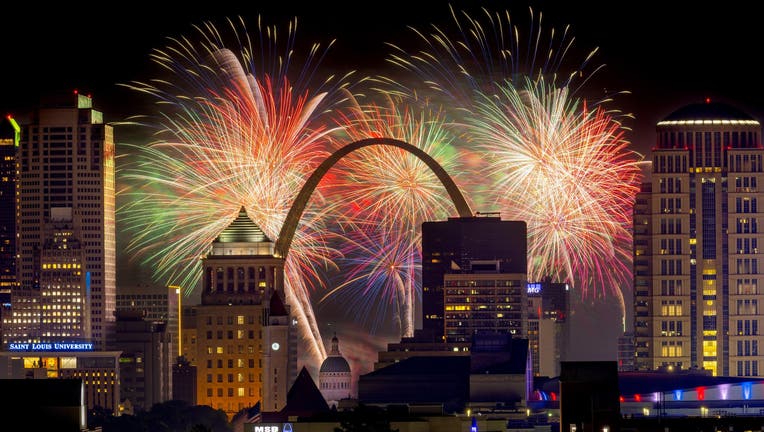
Fireworks explode over the St. Louis skyline and Arch as seen from the campus of St. Louis University on Friday, July 3, 2026. (David Carson/St. Louis Post-Dispatch)
As Americans gather to celebrate America’s 250th birthday, many will do so with fireworks, but smoke from the holiday explosions can lead to health problems, especially for sensitive groups, according to the American Lung Association.
Here’s how to protect yourself:
Fireworks pollution
What they're saying:
"When fireworks explode, they release gases such as sulfur dioxide, carbon dioxide and carbon monoxide, which are very harmful to our lungs," the American Lung Association explains on its website. "Their smoke releases other harmful metals into the air like aluminum, manganese and cadmium.
"Additionally, some illegal fireworks even contain lead, which is extremely dangerous and can cause long-term damage. Inhaling any of these chemicals is detrimental to health and can irritate the lungs, making it hard to breathe and causing serious health problems, which is why it is important to avoid firework smoke whenever possible."
MORE: July 4th fireworks: How to watch & stream fireworks displays from across the US
Why you should care:
The pollution released by fireworks is considered particle pollution, which temporarily boosts the level of airborne microscopic particles that can pose a health risk.
"Exposure to air pollution has been shown to increase cases of chronic cough and other lung diseases," the American Lung Association says. "If you have asthma or COPD (chronic obstructive pulmonary disease), pollution caused by firework smoke can exacerbate symptoms and cause flareups."
Dig deeper:
Fireworks that people set off at home can be even more dangerous, the American Lung Association says, "because the smoke stays closer to the ground where we breathe."
RELATED: Wildfires are reversing years of progress on US ozone pollution, study finds
By the numbers:
A 2015 study found that air pollution levels increased by an average of 42% on July 4, then generally returned to normal by noon on July 5.
How to protect yourself
The American Lung Association recommends that sensitive groups and people with lung diseases watch fireworks from upwind. If it’s smoky outside, you can avoid poor air quality by staying indoors, closing your windows and using your air conditioner on recirculate.
READ MORE: These US cities have the worst air quality in 2025
You can also monitor local air quality reports on AirNow.gov or other websites for real-time updates.
N95 masks recommended for America 250 fireworks
Local perspective:
In Washington, D.C., where the federal government is planning the largest fireworks display in history on the National Mall to celebrate America’s 250th birthday, particle pollution is expected to reach hazardous and "very unhealthy" levels, according to The Washington Post.
READ MORE: Wildfire smoke pollution linked to more than 24K deaths a year, study finds
Experts say people who are worried about inhaling fireworks smoke should consider wearing an N95 mask.
The Source: This report includes information from the American Lung Association, The Associated Press and The Washington Post.