

Loving A Lie: Chicago-area man loses $70,000 to AI-powered romance scam
Loving A Lie: Chicago-area man loses $70,000 to AI-powered romance scam
A Chicago-area man who thought he’d found a real relationship through online dating instead lost $70,000 to an AI-powered romance scam, highlighting how fast-growing fraud schemes are exploiting people’s desire for connection.
CHICAGO - A Chicago-area man met someone online who made him feel seen, heard, understood. They talked every day for months. He saw her face on video calls, heard her voice, built what felt like a real connection. That connection cost him $70,000, destroyed his ability to trust, and left him paying off debt he took on for someone who never existed.
What we know:
The man asked to be identified only as Grant Trust. He met "Kay" on Facebook Dating in 2024. What started as a casual conversation became something deeper, according to his account. They FaceTimed almost daily. She was not real.

How the scam unfolded
Grant and Kay talked every day for months. The relationship felt normal, comfortable even. That foundation of trust is exactly what made the scam work.
After several months of building that connection, Kay told Grant she was making money trading cryptocurrency, Grant said. She offered to show him how and suggested he start small with $100. Kay directed him to a trading app that displayed what appeared to be profits, according to Grant. He tested it by withdrawing a few thousand dollars. The withdrawal went through, so he continued investing.
Over time, Grant invested more money, including taking out a $40,000 loan, he said. In total, he lost $70,000. When he tried to withdraw a larger sum, the app locked him out. He confronted Kay through messages. "Why are you scamming people?" Grant wrote. According to Grant, her response was: "Because you are stupid."
Why you should care:
Romance scams are surging as artificial intelligence makes it easier and cheaper for criminals to create convincing fake identities, according to cybersecurity experts. The technology has fueled a 70% spike in AI-related fraud, experts say. People lose an average of $2,000 to a romance scam, according to the Better Business Bureau.
FOX 32 showed screenshots from Grant's conversations with cybersecurity expert Eithan Raviv. It took him five seconds to identify the profile as AI-generated. He noted red flags often seen in AI-generated profiles: photos that look too perfect, language patterns that feel unusually formal, and social media profiles that were just created.
"The funny part is that I used to think that I was smart enough not to get into it," Grant said.
But former FBI undercover operative Eric O'Neill, who now tracks romance scammers, said intelligence has nothing to do with it. The desire for connection does.
"What cybercrime criminals know is that we all suffer from a psychology called confirmation bias," O'Neill said. "When we see something that we truly want to be true, we will confirm it is true for ourselves."
We all want to believe someone cares about us, O'Neill said. Scammers exploit that fundamental human need.
After Grant lost everything, he looked online for help and found lawyers who promised to recover his money. He paid them $3,000. They were scammers too. Both experts warn that fake recovery services are often run by the same criminal networks behind the original scam.
Big picture view:
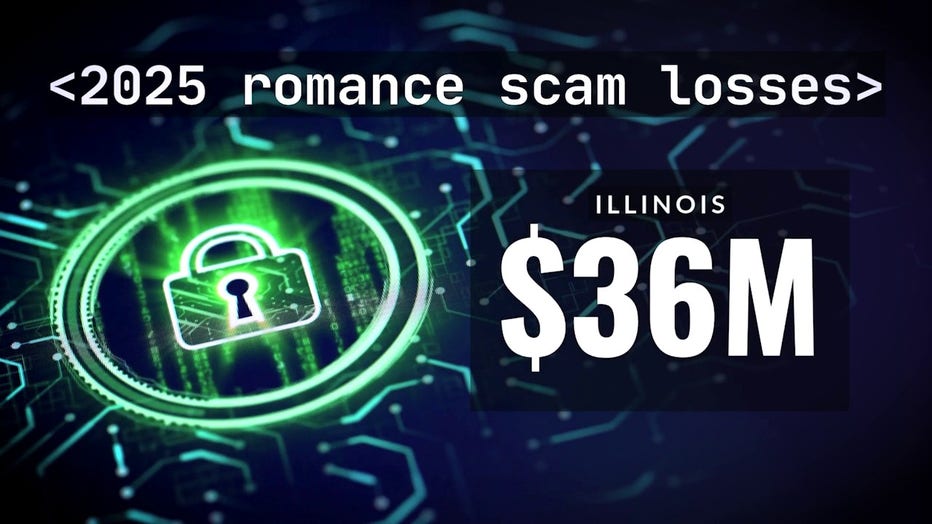
In 2024, Illinois residents lost $36 million to romance scams, ranking seventh in the country, according to data from the FBI's Internet Crime Complaint Center. Nationwide, losses topped $1 billion.
Grant reported Kay to the police and filed complaints with the FBI and Better Business Bureau, he said. He has not received any updates. Romance scammers are nearly impossible to catch, according to both O'Neill and Raviv. Most operate overseas, outside U.S. jurisdiction, using encrypted communication and untraceable payments, such as cryptocurrency.
The emotional toll
Days after Grant reported Kay to authorities, he found her profile again on the dating platform, he said. "Same face, different name, still active."
Grant is in therapy now and has deleted every dating app from his phone. He's making monthly payments on $70,000 in debt. The shame is what keeps most people quiet, Grant said, and he hasn't told anyone in his life what happened. But he agreed to speak publicly, with his identity hidden, because he knows what it feels like to want a connection so badly that he misses the warning signs. He wants others to see what he couldn't.
What you can do:
Pay attention when someone avoids meeting in person, when their stories keep changing, or when they rush intimacy. Reverse-image search their profile photos on a site like Google Images to see if the images appear elsewhere online.
The clearest red flag, according to both O'Neill and Raviv: when someone you met online asks for money or suggests investing together. Stop immediately. Be especially wary if someone asks you to send funds via wire transfer, money order, or prepaid card, as these methods are untraceable, according to the BBB.
If you've been scammed, report it to the FBI's Internet Crime Complaint Center at ic3.gov and contact your bank immediately. Do not pay anyone promising to recover your money for a fee. That is often the next scam.