

What is gerrymandering? The controversial tactic Texas Democrats are fighting

Illinois GOP call out Pritzker, Democrats for gerrymandering hypocrisy
Texas Democratic lawmakers continue their holdout in Illinois to prevent a Trump-backed redistricting plan. But Republicans in Illinois are calling out gerrymandered the state is to advantage Democrats.
CHICAGO - Democratic state lawmakers from Texas have fled to Illinois and other states in an attempt to block a Trump-backed effort to redraw the Lone State’s congressional districts to further advantage the GOP in the upcoming 2026 midterm elections.
While redrawing a state’s congressional districts is not unusual, the process typically happens every 10 years after a census, which last happened in 2020.
Dig deeper:
Still, Democrats are alleging that Republicans are trying to politically gerrymander Texas’ congressional districts to squeeze out extra GOP wins.
That’s especially important in a tightly contested House of Representatives in which Republicans have a slim 291-212 majority.
Gerrymandering has a long history in the U.S., and Republican opponents have pointed out that Illinois state lawmakers are also guilty of drawing their maps to give Democrats an advantage.
What is gerrymandering?
Gerrymandering refers to a specific type of redrawing of legislative districts to give one political party an advantage.
Districts can be drawn to include more Democratic voters to ensure Democrats win in future elections, for example.
Such districts essentially pre-determine an outcome, making it nearly impossible for a Republican (in this example) to win. It has resulted in very few truly competitive congressional districts, sometimes called "swing" districts, across the country.
The Cook Political Report has categorized only 18 U.S House districts out of 435.

Texas Democrats flee to Illinois: Reporters from Chicago and Houston break down the ‘drama’
Why did Democrats flee Texas for Illinois? Fox Chicago’s Paris Schutz and Fox Houston’s Lina deFlorias explain what’s happening, how we got here, and what could happen next.
How does redistricting work?
Historically, state lawmakers have been responsible for redrawing congressional districts every decade or so to account for population changes.
Redistricting usually happens after a census count is completed so that lawmakers have the latest data on their own state’s population.
Lawmakers, including in Illinois, usually need to draw districts that meet a few parameters.
- Each district must have roughly the same number of people. That includes adults, children, citizens, and non-citizens.
- Each district must also be contiguous, meaning "you can travel from any point in the district to any other point in the district without crossing the district’s boundary," according to Loyola Marymount University’s Law School’s "All About Redistricting" website. Basically, the district cannot be broken up into multiple parts and its borders all have to connect.
- Each district must also be reasonably "compact." But many critics of gerrymandering point to oddly-shaped districts that don’t appear to abide by this requirement, including in Illinois.
Lawmakers should also try to keep "communities of interest" together in a legislative district. This is a broad term that can refer to people in a certain municipality or people of a certain racial or ethnic group.
But drawing districts along racial lines can also be fraught, since it is illegal to racially gerrymander, or draw districts to dilute the voting power of racial minorities.
Is Illinois gerrymandered?
If you ask Republicans in Illinois and many experts on the matter, the answer is yes.
Democrats have dominated in state electoral politics, even more so than one would expect, considering Democrats do win statewide by healthy margins. Former Vice President Kamala Harris won the state over President Trump by a 54.8% to 43.8% margin.
Among the state’s 17 congressional districts, Democrats won 14 of them, and Republicans only won three in the 2024 elections.
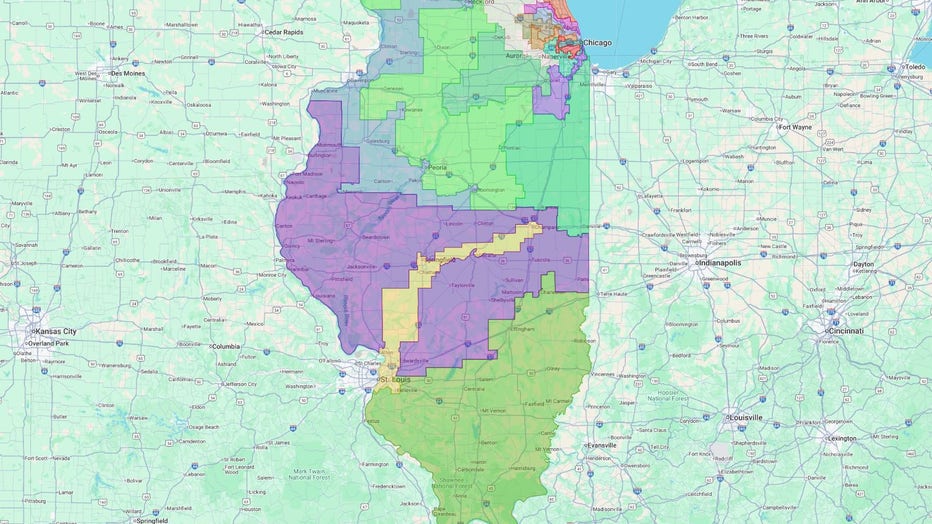
Republicans claim Illinois' congressional districts are gerrymandered, or drawn to advantage Democratic politicians. (Illinois House Democrats)
Democrats also have significant majorities in the state legislature, with a 78-40 majority in the House and a 40-19 majority in the Senate.
Princeton University’s Gerrymandering Project gave Illinois’ congressional districts an "F" for partisan fairness, competitiveness, and geographic features.
On Monday, political analyst Thom Serafin told Fox 32 that Illinois was "the most gerrymandered state in the union" and that it "has been gerrymandered to death."
On Tuesday, the DuPage County GOP posted on social media an example of Illinois' 4th Congressional District to illustrate how the state is gerrymandered.