

How Chicago shaped Barack Obama: From ‘a place to start’ to the national stage
CHICAGO - This weekend’s opening of the Obama Presidential Center in Chicago represents something of a culmination of the life’s work of the 44th President of the United States, a man whose legacy, for better or worse, has been felt by millions of people across the country and the world.
The center’s location on Chicago’s South Side is just the latest connection between Obama and the city he came to more than 40 years ago to begin his career in community organizing, law and politics, eventually leading him to the White House.
It was in Chicago that Obama got his first real-world experience, where he "grew up" and would eventually catch the bug of politics.
Obama has written at length about his early years in Chicago, including in his most recent book, "A Promised Land," published in 2020.
"If my own impact on Chicago was small, the city changed the arc of my life," he wrote in the book.
‘A place to start’
After graduating from Columbia University in New York City in 1983, Obama wrote that he had "big ideas and nowhere to go."
He said after bouncing around at a few jobs there, he heard about a job as a community organizer in Chicago.
For a starting salary of about $10,000, he’d work with churches to "stabilize communities racked by steel plant closures." His first apartment was a "comfortable studio" at 1440 East 52nd Street, according to a biography of Obama by journalist David Maraniss.
"Nothing grand, but a place to start," Obama wrote.
Those steel plant closures cost thousands of jobs on Chicago’s South Side, resulting in economic depression for many Black residents across the area. For Obama, trying to organize those communities dealing with such hardship led to victories that were "small and transitory," he wrote.
Obama added that by the mid-1980s, communities on Chicago’s South Side had been experiencing the kind of deindustrialization that many other parts of the country were also feeling. On top of deindustrialization, parts of Chicago had also experienced white flight, the phenomenon of white residents fleeing the city for the suburbs.
Gerald Kellman was the man who hired Obama as a community organizer. He said the communities that relied on those steel plant jobs were beginning to unravel economically and feel those consequences on top of the effects of decades of segregation.
"We couldn't get the steel mills open again," said Kellman. "All we could do was deal with the repercussions and what was happening to people."
Obama wrote about the stumbling blocks he encountered trying to achieve even modest improvements, like fixing up local parks, removing asbestos from a South Side housing complex, or starting an after-school program.
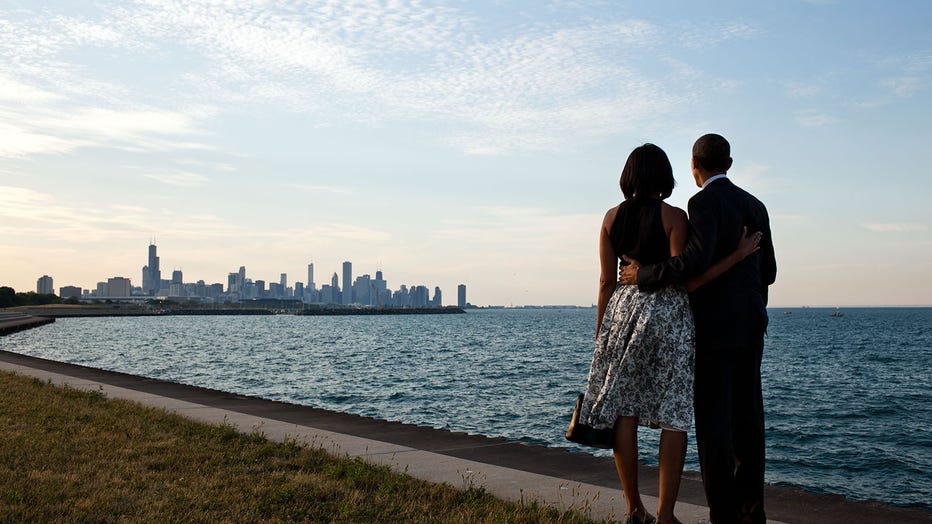
June 15, 2012 "We had just arrived at the helicopter landing zone in Chicago and instead of walking right to the motorcade, the President and First Lady walked past their vehicle to the edge of Lake Michigan to view the skyline of their home town." (
Kellman added that what they were trying to do was difficult work, and, arguably, they failed at their task, considering that many predominantly Black communities on Chicago’s South Side continue to experience high levels of poverty and disinvestment. Even for smart and accomplished young people, like Obama, the work of organizing in distressed communities might be the first time they've experienced such failure.
PBS Frontline published a letter Obama wrote to a friend during those early years.
"It’s tough…lots of driving, lots of hours on the phone trying to break through lethargy, lots of dull meetings," he wrote. "Lots of frustration…"
But it was through those experiences that Obama said he learned about what mattered to real people and what it took to get things done.
"I experienced failure and learned to buck up so I could rally those who’d put their trust in me," he wrote in "A Promised Land." "I suffered rejections and insults often enough to stop fearing them.
"In other words, I grew up."
It was also around that time in Chicago when Obama learned from afar some valuable political lessons from the tenure of Mayor Harold Washington, the city’s first Black mayor. Washington was able to beat the so-called "machine" and break through the city’s racially and ethnically divided politics to get elected.
But, Obama also said he saw how those racial politics led to heated battles in City Hall, often referred to as the "Council Wars," in which a majority bloc of white aldermen blocked many of Washington’s appointments to city boards and departments. It wasn’t until a federal court ordered the redrawing of racially gerrymandered wards that Washington was able to overcome the fierce opposition.
Still, that success was short-lived as Washington died just a few months into his second term in November 1987.
The racist backlash notwithstanding, Obama praised Washington’s record, which included a more equitable distribution of city services and new schools in lower-income neighborhoods. He wrote that Washington "gave people hope," especially Black Chicagoans.
But Obama stressed what he learned about the political limitations of Washington’s rise.
"I saw how the tremendous energy of the movement couldn’t be sustained without structure, organization, and skills in governance," he wrote. "I saw how a political campaign based on racial redress, no matter how reasonable, generated fear and backlash and ultimately placed limits on progress. And in the rapid collapse of Harold’s coalition after his death, I saw the danger of relying on a single charismatic leader to bring about change."
This episode of Chicago’s political history also "planted a seed" in Obama that one day he might run for public office, he wrote. Still, he said he wanted to learn from the mistakes of Washington and get the "policy know-how and management skills" necessary to succeed.
He also admitted that his personal ambition drove him toward his next career step: Harvard Law School.
An unusual path
At Harvard, Obama stood out as a star among stars, which he attributed, at least in part, to his being a bit older than most of his classmates. He made national news as the first Black editor of the prestigious Harvard Law Review.
While Obama was a student at Harvard, Chicago still proved to have a tremendous impact on his life. He took a summer position at the Chicago law firm Sidley & Austin, where he met Michelle Robinson, who was an associate there after earning her own Harvard law degree. The two would later marry.
Obama graduated near the top of his law school class, which would have set him up for a well-worn path to success: a federal court clerkship and then a high-powered career in law, politics, or business.
But that was not the path Obama chose after graduation.
Geoffrey R. Stone has taught at the University of Chicago’s Law School since 1973 and was dean when he learned about Obama. Stone brought him in to interview for a potential teaching position. Obama impressed Stone and the other UChicago faculty members.
"After he left, my secretary, who had spent 20 minutes talking to [Obama], said to me, ‘That guy is absolutely a star. He’s gonna be governor of Illinois someday,’" Stone said in an interview with Fox Chicago.
Stone offered Obama an opportunity to write what would become his book, "Dreams From My Father," during his first year at UChicago’s Law School. Obama would later become a lecturer and teach the university’s law students.
Stone said the path Obama took was "very unusual" for someone who had achieved so much at a prestigious law school. He added that, besides Obama, he’s never really seen top students not pursue clerkships and the more traditional legal career route.
"He was very determined to pursue his own interests," Stone said. "And it wasn’t politics necessarily."
Stone said Obama was well-regarded as a teacher: demanding, but with an open mind.
"[He] didn’t feel any need to attempt to persuade his students that he had the right answer to these complicated questions, but rather wanted to get them to think about them, and to argue with one another about them and let them figure it out for themselves," he said. "And that’s partly why he was so successful as a teacher."
Stone added that Obama’s intellectual openness and ability to hear different views helped shape him as a teacher, and beyond.
"I think that's one of the great characteristics that he has, and made him an excellent president, and an excellent national leader," Stone said. "And we need to find a way to go back to that."
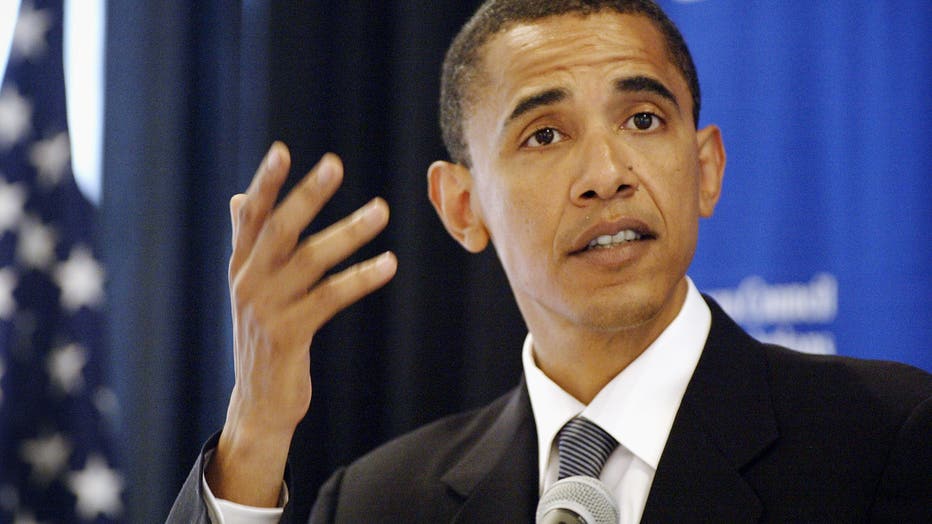
CHICAGO - JULY 12: Democratic candidate for U.S. Senate, Barack Obama, gestures as he speaks to members of the Chicago Council on Foreign Relations July 12, 2004 in Chicago, Illinois. Obama, who is seeking the seat being vacated by Senator Peter Fitz
Blood sport
Obama’s first foray into electoral politics came in 1995, when then-State Sen. Alice Palmer, a Democrat representing parts of Chicago’s South Side, decided to run in a special election for an open Congressional seat.
He backed Palmer’s campaign, and others encouraged him to run in her place for the State Senate. Palmer, Obama wrote, agreed to endorse him, but the timing was such that she still had the option to run for her seat again if her Congressional bid didn’t work out. Obama said Palmer gave him her word that she was done with the state legislature.
Palmer lost that special election, and some of her longtime supporters, some very "prominent Chicagoans," as he put it, asked Obama to get out of the race.
He refused and argued that he already had voters and donors invested in his campaign.
"I felt disheartened and betrayed," he wrote.
Even though Palmer announced she’d run again for her seat, Obama and his team figured "all was not lost."
His campaign staff used a tried-and-true method to clear Obama’s path to victory: challenging his opponents’ paperwork. Candidates need to collect a certain number of qualified signatures from constituents on petitions to get their name listed on the ballot. Many times, opponents contest the legitimacy of those signatures, and if a candidate is found not to have the requisite number, they could be knocked off the ballot.
Obama successfully challenged not just Palmer’s petitions but those of his other Democratic primary opponents. He said that was when he acquired a respect for "the nuts and bolts of politics" and the "attention to detail" needed to win.
He would go on to win the general election easily and become a state senator.
"It confirmed, too, what I already knew about myself: that whatever preferences I had for fair play, I didn’t like to lose," he wrote.
Just a few years later, in 2000, Obama saw another opportunity for higher office and tried to challenge U.S. Rep. Bobby Rush, a former Black Panther and prominent figure in Chicago politics.
Obama conceded his decision to challenge Rush was "stupid."
Rush told an interviewer for the Obama Presidency Oral History project in 2021 that he was surprised to learn about the challenge from the young upstart. He and Obama weren’t particularly close but had a "respect for one another."
Rush had risen from an activist during the Civil Rights Movement to the Black Panther Party, and eventually to elected office as a Chicago city alderman for a decade before winning his seat in Congress in 1992, which he would hold for the next 30 years.
In 1999, Rush unsuccessfully ran for mayor of Chicago against incumbent Richard M. Daley, which gave some the impression that he was vulnerable. That’s when Obama decided to try his luck.
Some allies warned Obama that Rush was still a formidable opponent with deep roots and high approval ratings in his district. For his part, Rush said he wasn’t intimidated by the challenge. During the race, Obama faced questions over his identity, about him not being from Chicago, his Ivy League credentials, and even whether he was actually Black. Rush called Obama an "educated fool."
"Politics in Chicago are a blood sport," Rush said in that 2021 interview.
Years later, Rush framed the race as being between someone who had "been tested" against someone whom voters "really didn’t know." He believed Obama miscalculated and underestimated Rush's sway among his own constituents.
Rush won the primary by a two-to-one margin. It would be the only election Obama would ever lose.
But the loss turned out to be a benefit for Obama, at least according to his allies. Kellman and others have said that if Obama had become the congressman from the district, representing largely Black communities, it might have been harder for him to run for even higher office.
"He had to lose in order to win," Kellman said in his own oral history interview in 2022. "It was a great gift, which sure did not feel like one at the time."
That gift bore fruit in 2004 when Obama decided to run for the U.S. Senate. By that time, he had improved as a politician and garnered support from his General Assembly colleagues throughout the state. He would score a convincing win in a large Democratic primary field. The Republican candidate would eventually drop out and be replaced, which was yet another boon for Obama's campaign. He would go on to be a U.S. senator.
But it was an invitation from John Kerry’s presidential campaign to deliver a keynote speech at that summer’s Democratic National Convention in Boston that would prove to be the launchpad for his status as a national political figure.
Amid the backdrop of two wars and rising political polarization, Obama spoke about his family’s story, how there was no "Black America" and "white America," and about the "audacity of hope." The 16-minute speech captivated the audience. It had the kind of unifying message that Obama would use with great success just a few years later in his own presidential bid.
Despite the high-minded rhetoric of his speech, his presidency would, at least in part, be defined by political polarization, the public's disillusionment with American institutions and a reckoning with the election of the country's first Black president.
But, in the immediate aftermath of his speech, those battles were still to come. For now, Obama was on his meteoric ascent.
In just two decades since he arrived in Chicago, he grew from a community organizer to an upstart politician and then a national figure about to take his own place in American history.