

The surgery that helped one suburban Chicago woman feel whole after breast cancer
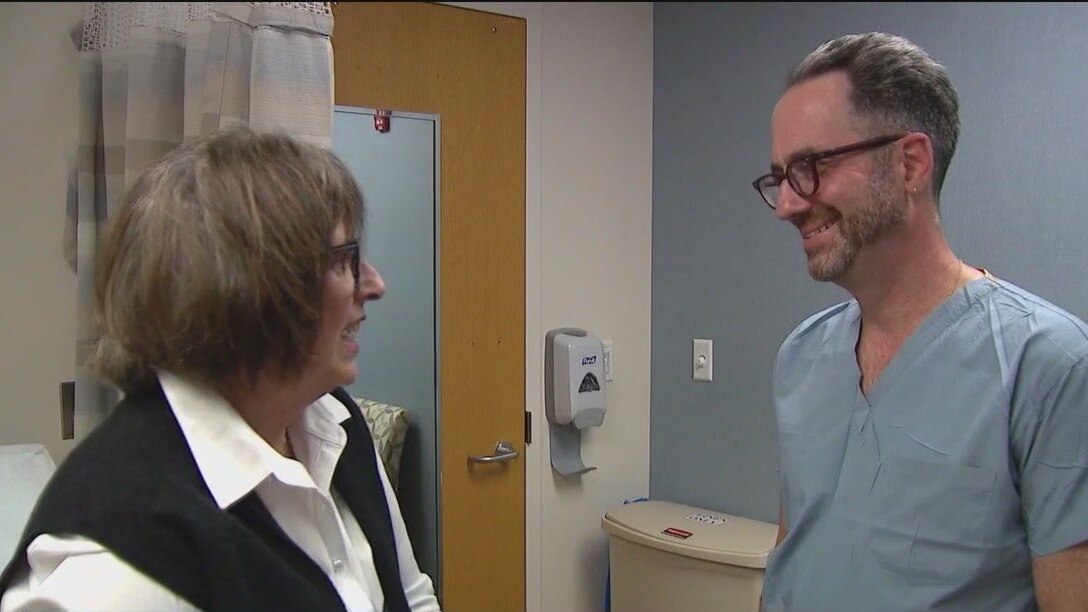
A surgery that helped Chicago woman feel whole after breast cancer
The American Cancer Society says over 300,000 women will be diagnosed with invasive breast cancer this year. For some, that means having surgery, maybe even more than once to make sure all the cancer is gone.
CHICAGO - The American Cancer Society estimates over 300,000 women will be diagnosed with an invasive breast cancer this year.
For some women, that means having surgery — sometimes more than once — to make sure all the cancer cells have been removed.
In a Fox 32 special report, Dawn Hasbrouck takes a look at a procedure one Chicago area hospital is offering that not only helps preserve the patient's breast but her sense of self too.
Blending medicine and aesthetics
What we know:
"I still see it in the mirror," said Jody Simmons, a breast cancer patient. "Scars are fading. I don't feel distorted. I mean, for me, I was more concerned about that. I'm not a very vain person, but it was more about feeling whole afterwards."
When she was diagnosed two years ago following a routine mammogram, Simmons says she didn’t really know what to expect when it came to her surgical options.
"So, when this option was given to me, I thought it was a great way to approach the recovery and, for me, a healthier way to approach the recovery. And I think the recovery was not awful, and it's much easier seeing you look the way that you expect to look.
"So Jody was diagnosed with a stage zero breast cancer, which is a good thing in that it's caught so early," said Dr. Catherine Pesce, an oncologist at Endeavor Health. "But it is a type of breast cancer that we can't see or feel. It's more of a microscopic disease. I often describe it as a sprinkling of cells throughout the breast. And sometimes we really do need to remove quite a bit of tissue in order to make sure we get it all."
Pesce is Simmons’ breast cancer surgeon.
"As a breast surgeon, we're always worried about, am I gonna make you asymmetrical if I remove too much tissue on one side? Which, you know, I view as a disservice to women. I never want to do that to a patient. So, really, with this situation she was in, I talked to her about that, and that I didn't want to have that as a potential side effect with resection," Pesce said.
So Pesce talked to Simmons about a surgical option she hadn’t heard of that could stop that side effect from happening.
The oncoplastic breast reduction
"So an oncoplastic breast reduction is a way that we meld a breast cancer operation with an esthetic breast procedure," said Dr. Mark Sisco, head of plastic surgery at Endeavor Health.
Sisco is the plastic surgeon who worked side by side with Pesce when performing this procedure on Simmons at Endeavor Health's Evanston hospital.
"This is, I think, one of the few operations where a cancer patient could go to sleep. Have their cancer removed and wake up feeling better about their body than they went to sleep. And I think that's one of the really great things about the procedure," Sisco said.
So in Simmons’s case, Pesce performed a lumpectomy on her left breast while Sisco did a small breast reduction on her right side.
He also rearranged some of the tissue on the left side to help keep her looking balanced and feeling normal.
"So, a lumpectomy alone takes about an hour. It's outpatient surgery, recovery, I tell women is about a week. By doing an oncoplastic reduction in addition, really it doesn't add much to the recovery at all. We usually say maybe a total of two weeks instead of one week," Pesce said.
"And I think the other nice thing is it's not uncommon that people with a larger tumor were able to avoid a mastectomy, you know. And a lot of these people with larger tumors, a lot of these women in the past would have required a mastectomy, which is a much more challenging operation to go through. It takes more work to rebuild the breast after a mastectomy, it technically has multiple procedures. This offers the operation of maintaining sensation in the vast majority of cases," Sisco said.
Sisco added that patients do better if these procedures are done at the same time and in conjunction with the rest of their cancer treatment.
"Number one, we're avoiding a second surgery in a lot of cases. And as I mentioned, when people have radiation or other treatments, that can change the breast in ways. And that can oftentimes make it more difficult to come in after the treatment is completely done and fix things," Sisco said.
Fewer surgeries, better outcomes
Perhaps one of the biggest benefits of this procedure is this.
"I would say one of the biggest advantages of the surgery is because we are removing tissue from both breasts, we can go a little bit wider with our margins to really ensure that we get clean margins in one surgery," Pesce said.
Clean margins mean less chance of the cancer coming back. That’s something Pesce and her team check for in the operating room.
"We actually do take an x-ray right then and there while we're in surgery. And we can often see where the lesion is on the specimen, and we're hoping that it's right in the middle of the lesion. We're hoping to see a nice, clear amount of tissue around it. And usually, that can ensure that we're getting clean margins," Pesce said.
Because it’s a microscopic disease, they still send the tissue they've removed to pathology.
"More often than not, you know, most women do just fine, and we don't sign them up for the surgery unless we really think there's a really good chance we're going to be just fine," Pesce said.
But for many women in the U.S., the opportunity to have this type of surgery may not be possible.
Research articles in the National Library of Medicine cite a potential lack of available reconstructive plastic surgeons in some areas. Another issue is simply being able to schedule the doctors to perform the procedure at the same time. At the same time.
That doesn’t seem to be a problem for Simmons’s surgical dream team.
"Our schedules, we're able to line them up so that, you know, we have a lot of surgery time available for our patients. It's very common we’ll do three or four of these in one day," Pesce said.
What you can do:
For Simmons, she's glad she had the opportunity to choose this type of surgery.
"It was a choice, and I chose to do it, and I'm really glad that I did because you look at the scars every day in the mirror, and it just makes you feel, or at least for me it made me whole," Simmons said.
The doctors we spoke with added patients should advocate for themselves and ask if this procedure is available when considering their surgical options.
The Source: For this story, the Fox 32 Special Projects Unit spoke with Dr. Catherine Pesce, Dr. Mark Sisco, and patient Jody Simmons at Endeavor Health’s Evanston Hospital.